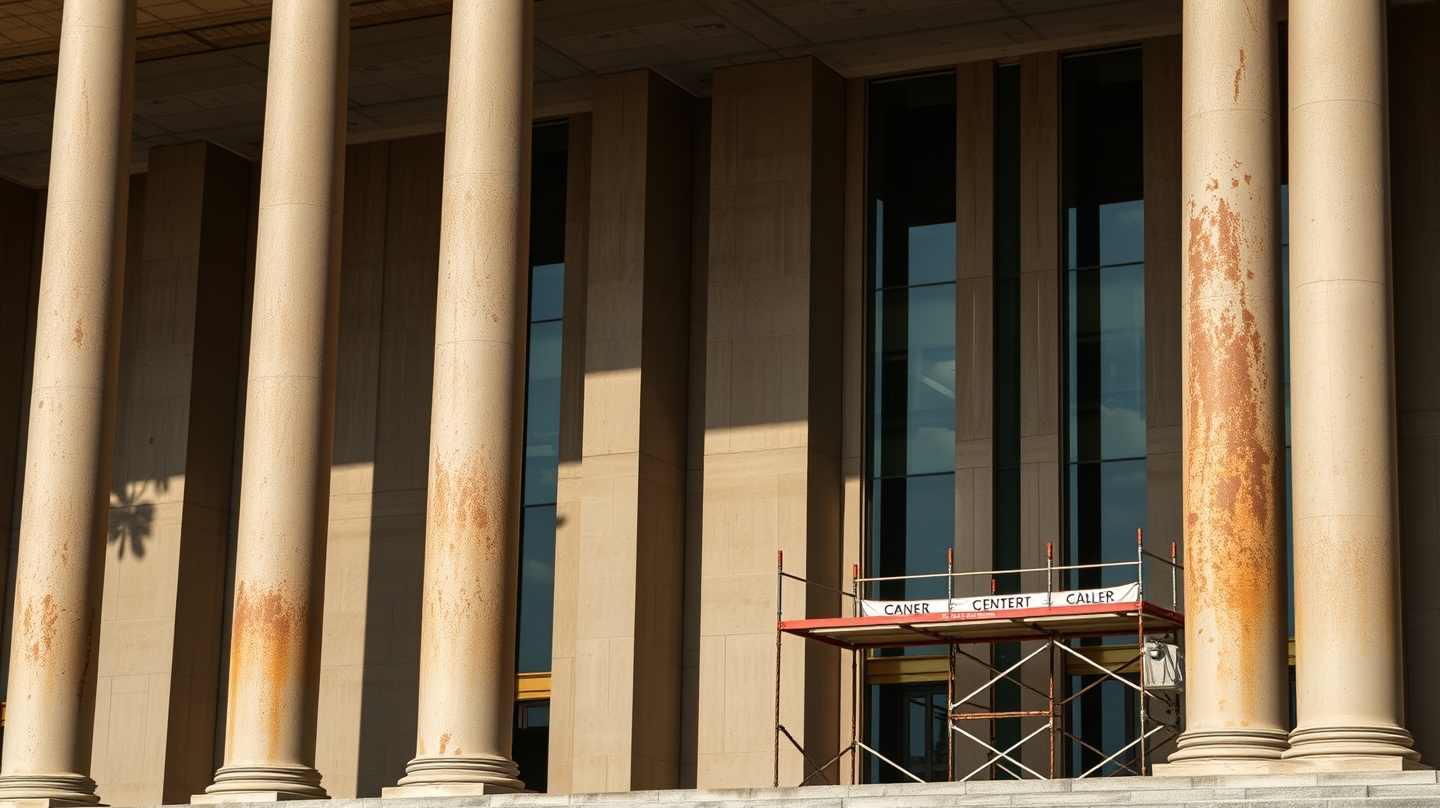
When the Kennedy Center scrambled to finish cosmetic upgrades before a December 2025 ceremony featuring President Donald Trump and the FIFA Peace Prize, the rush backfired. Former project managers, speaking through a whistleblower report submitted to Congress, say shortcuts led to rusting steel columns, peeling paint on a reflecting pool, and acoustically compromised flooring—all of which will now cost the center millions to correct.
The report, provided to the Senate Committee on Environment and Public Works by the Government Accountability Project, alleges that the center’s leadership bypassed standard procurement rules and used no‑bid contracts to meet an aesthetic deadline. Contractors applied a sub‑standard primer to exterior columns, a decision that now requires an estimated $1.8 million repaint to halt rust exposure. Similar shortcuts affected a reflecting pool, a concert‑hall floor, and even the tile color in the presidential box bathrooms.
Senator Sheldon Whitehouse, the committee’s ranking member, highlighted the discrepancy between the center’s congressional pledge—"prudent and efficient" use of $257 million appropriated in the One Big Beautiful Bill Act—and the reality of rushed, non‑compliant work. The legislation was intended to address a backlog of structural repairs, yet the focus shifted to cosmetic changes driven by the White House’s aesthetic preferences.
Beyond the immediate financial hit, the episode underscores a broader industry challenge: the failure to integrate technology‑driven automation into large‑scale renovation projects. Modern construction management platforms can enforce procurement compliance, track material specifications in real time, and flag deviations before they become costly rework. In the Kennedy Center case, a lack of such tools allowed a cheaper primer to be used without proper documentation, leading to premature corrosion.
Automation also offers predictive analytics for acoustical performance. The newly installed concert‑hall floor, laid without acoustic modeling, may require retrofitting to meet the venue’s sound standards—a fix that could have been avoided with digital simulation tools. As the performing‑arts sector increasingly relies on high‑fidelity sound, integrating these technologies becomes a matter of both artistic integrity and fiscal responsibility.
Real‑world implications extend to other cultural institutions facing aging infrastructure. When budgetary pressures intersect with political timelines, the temptation to cut corners rises. However, adopting workflow automation—such as cloud‑based contract management, AI‑assisted quality inspections, and IoT‑enabled material monitoring—can provide the transparency needed to balance speed with safety.
Congressional oversight may intensify. The Senate letter notes that the center failed to secure a Federal Acquisition Regulation (FAR) deviation for its no‑bid contracts, a procedural lapse that could trigger further audits. For taxpayers, the lesson is clear: short‑term aesthetic gains should not eclipse long‑term structural health, especially when public funds are at stake.
Looking ahead, the Kennedy Center’s experience could catalyze a shift toward technology adoption across the cultural‑venue ecosystem. By embedding automation into procurement, scheduling, and quality control, institutions can safeguard both their historic fabric and the public resources that preserve it.




















