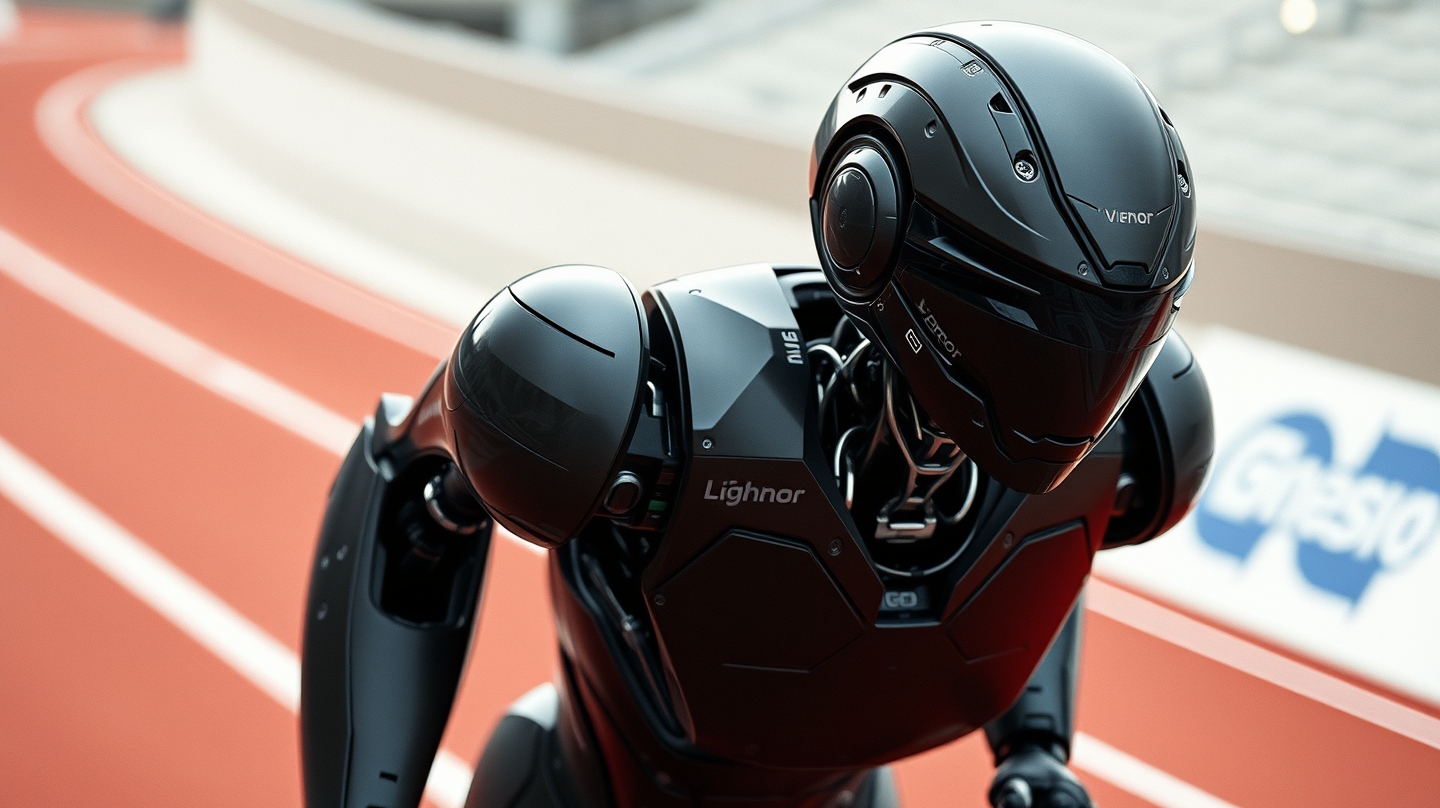
The Honor Lightning humanoid robot made history on April 19, 2026, by completing a half-marathon in a record-breaking 50 minutes and 26 seconds, surpassing the human world record by 7 minutes and the best robot time from 2025 by almost two hours. But what's behind this remarkable feat? Is it a magical technology or technique that unlocked this performance? To answer these questions, we need to delve into the fundamental constraints of running and the innovative solutions employed by the Honor Lightning team.
Running consists of alternating phases of a leg pushing against the ground (stance phase) and the body flying through the air (aerial phase). In the aerial phase, the body falls due to gravity, losing vertical momentum. The leg in stance phase pushes against the ground to redirect the vertical momentum upward, while the other leg swings forward to reposition for the next foothold. Electric motors use energy to produce torque, and adding a geartrain after the motor amplifies its torque and reduces its speed. However, a large reduction can make the rotor of the motor sluggish at accelerating its output, which is detrimental to the swing phase.
The Honor Lightning's motor specifications are not publicly available, but the hip and knee motors have an outer diameter of approximately 110-150mm. Using a simple physics model and the ILM115x25 motor as a reference, we can estimate the power consumption for running at 7 m/s (the Lightning's average half-marathon speed) as gear ratio varies. The optimal gearing is around 45:1, which results in a reasonable 400W power consumption. However, the dissipated knee power is approximately 150W, which is a significant challenge for prolonged periods.
The Honor Lightning team has addressed this challenge with a innovative liquid cooling system, where the cooling pipes penetrate deep into the motors like capillaries. The high-power liquid pump has a heat-exchange flow rate of more than 4 liters per minute, and each of the four drive motors in the lower limbs has an independent liquid-cooling circuit. This technology is not new, but its application in a humanoid robot is a significant breakthrough.
The implications of this achievement are far-reaching. The Honor Lightning's success demonstrates the potential of humanoid robots in various applications, from search and rescue to healthcare and education. The innovative liquid cooling system can be applied to other areas, such as high-performance computing and electric vehicles. As the technology continues to evolve, we can expect to see more advanced humanoid robots that can perform complex tasks with precision and efficiency.
In conclusion, the Honor Lightning humanoid robot's record-breaking half-marathon run is a testament to the power of innovation and technological advancements. The team's use of liquid cooling technology has addressed a significant challenge in robotics, and their achievement has opened up new possibilities for the development of humanoid robots.




















