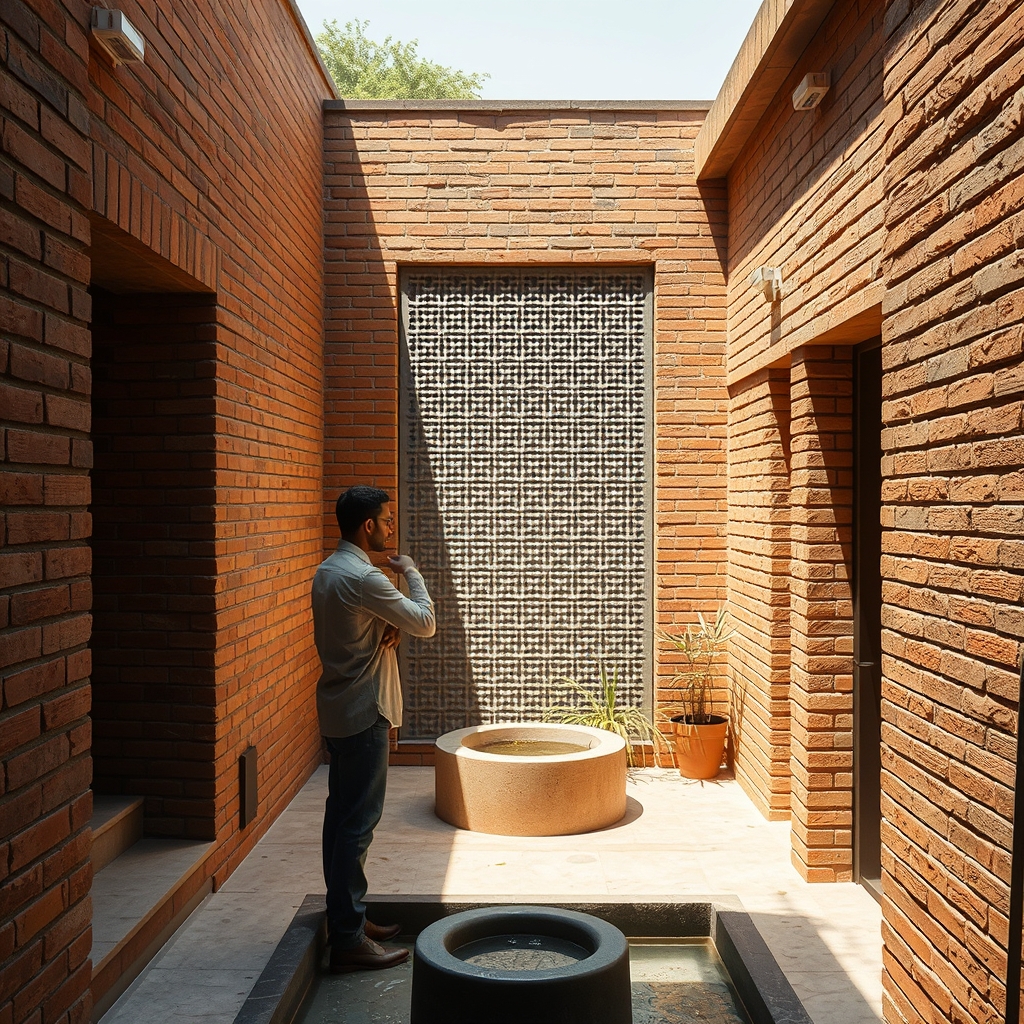
Brick House, a newly completed private residence in Pune's dense urban core, occupies a compact 4,500‑square‑foot footprint. The three‑storey home confronts the city's tight lot sizes and the region's monsoon climate through a restrained material palette of exposed brick, lime plaster, and timber. Its layout reinterprets traditional Indian courtyard principles, channeling breezes and diffusing light while fitting within the narrow street frontage. By embedding passive cooling strategies and discreet smart‑home controls, the house seeks comfort without reliance on energy‑intensive air conditioning.
Reinterpreting Vernacular Form in a Dense City
The façade's brickwork, left raw, recalls the earth‑bound construction of historic Pune neighborhoods, yet its modular proportions respond to the efficiency demanded by contemporary plots. A perforated jali screen, inspired by latticework found in Mughal palaces, mediates the tension between spatial efficiency and cultural expression: it admits filtered daylight while shielding interiors from harsh sun, creating a subtle play of shadow that changes with the season.
Inside, the central courtyard—scaled down to fit the limited site—acts as a thermal sink. The faint scent of wet lime plaster rises after a monsoon shower, and the cool stone floor underfoot offers a tactile reminder of the building's passive strategy. The architect lingered at the threshold, adjusting the depth of the jali screen to balance light and privacy, a moment of hesitation that shaped the house's final rhythm.
Smart appliances are woven into the design without overt display; a wall‑mounted thermostat blends with the timber paneling, allowing occupants to fine‑tune ventilation while preserving the aesthetic restraint. This integration illustrates how technology can serve, rather than dominate, a culturally anchored architecture.
Brick House matters because it shows how culturally rooted design can reconcile urban density with climate comfort in India's growing cities.
Beyond the Plot
In a broader context, the residence participates in a resurgence of vernacular thinking across Indian megacities, where architects revisit climate‑responsive tactics once taken for granted. By doing so, they challenge the prevailing narrative that modernity requires homogenised glass towers, offering instead a model where heritage informs sustainability.
As the city expands, homes like Brick House suggest a path forward: compact footprints that honour tradition, employ passive performance, and quietly embrace digital convenience. The result is a dwelling that feels both of its place and of its time.
Looking outward, the project invites other urban dwellers to consider how modest material choices and thoughtful form can shape more livable, resilient neighborhoods.




















