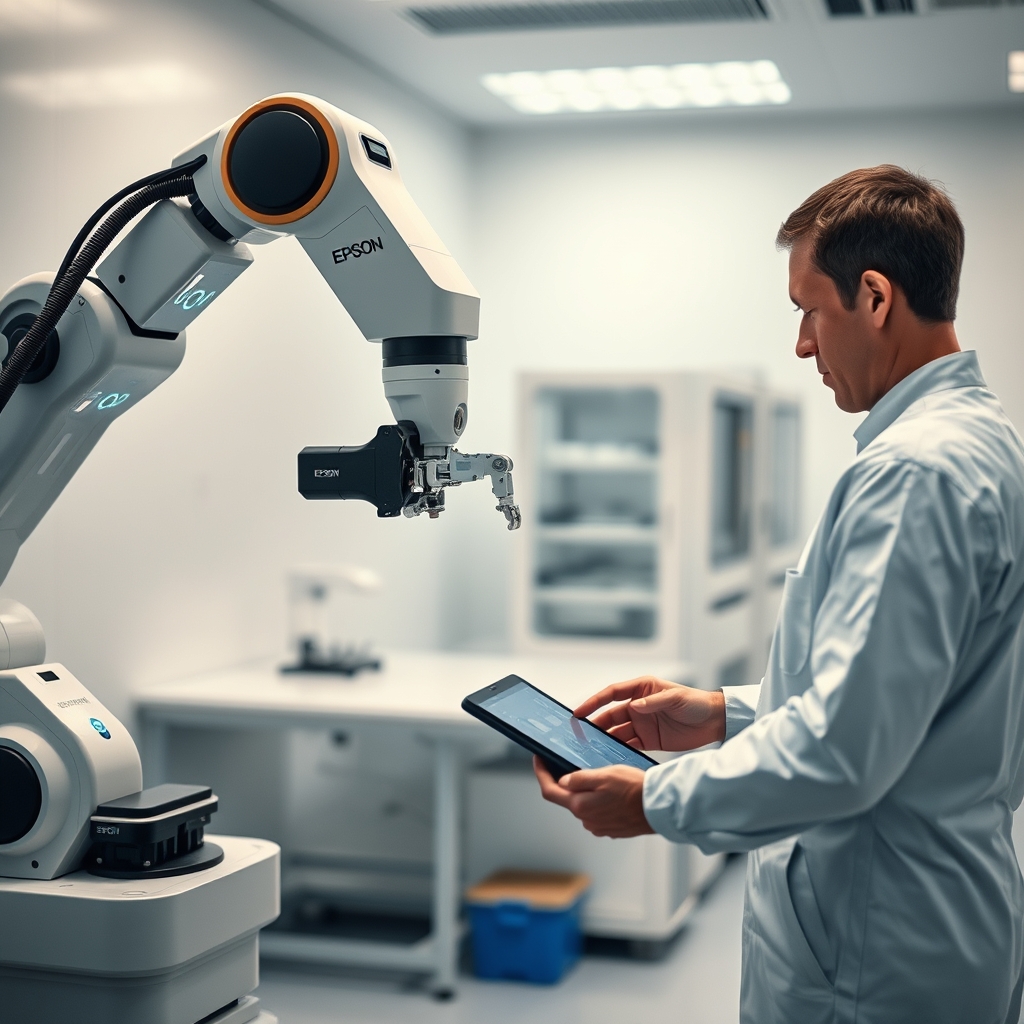
When a robot can move a sensor across a sterile bench without a safety cage, the line between human and machine workspaces blurs in a way few expected. Epson Robots’ newest six‑axis cobot, the AX6, arrives with a 900 mm reach, a 6 kg payload, and a no‑code programming environment that lets operators teach positions by hand‑guiding the arm.
Designed for power‑ and force‑limiting operation, the AX6 can share a work cell with people after a standard risk assessment, eliminating the need for traditional safety barriers. "Collaborative robots have lowered the barriers to entry for many new robot users by simplifying programming and integration," said Rick Brookshire, director for product and robot development at Epson. The company positions the AX6 as the bridge between high‑speed industrial arms and flexible collaborative tools.
Beyond safety, the AX6 packs a suite of features aimed at reducing the skill gap. Its AX Portal software runs on an Ethernet‑enabled controller and can be accessed from any web‑enabled tablet, turning a standard industrial tablet into a teach pendant. A customizable Python environment lets developers upload libraries for complex workcells, while a set of end‑of‑arm buttons enables “teach‑by‑hand” motions without writing a single line of code.
The cobot also meets ISO 14644‑1 Class 5 cleanroom standards, opening doors for life‑science applications that require strict contamination control. James Shimano, product manager at Epson, highlighted the appeal for monitoring tasks where a sensor must be moved precisely across a sterile field. In biotechnology labs, the AX6 could automate sample‑handling routines that currently rely on manual technicians, freeing skilled staff for higher‑value analysis.
Media production is another emerging arena. Automation‑driven media infrastructure increasingly relies on repeatable, precise motion for tasks such as camera rigging, lighting adjustments, and set piece placement. The AX6’s compact footprint and easy‑programming model allow small studios to integrate robotic assistance without hiring dedicated robotics engineers.
From a market perspective, Epson’s claim of more than 250,000 units sold worldwide underscores the growing acceptance of SCARA and collaborative robots across sectors ranging from automotive to pharmaceuticals. The AX6 extends that footprint by targeting tight‑space environments and users who lack deep robotics expertise, a shift that could accelerate automation adoption in midsize enterprises that previously found the investment prohibitive.
Structural insight: the convergence of no‑code interfaces with cleanroom‑grade hardware signals a broader trend where automation tools become as user‑friendly as office software. This democratization reshapes workforce dynamics, prompting manufacturers to rethink training programs and safety protocols while still preserving the human element for decision‑making.
Real‑world implication: a midsize biotech firm that adopts the AX6 can reduce sample‑handling time by up to 30 percent, lower contamination risk, and reallocate technicians to data interpretation, directly impacting time‑to‑market for critical therapies.
Overall, Epson’s AX6 illustrates how incremental advances—simpler programming, tighter safety integration, and cleanroom compliance—collectively push collaborative robotics from niche labs into mainstream production lines.




















