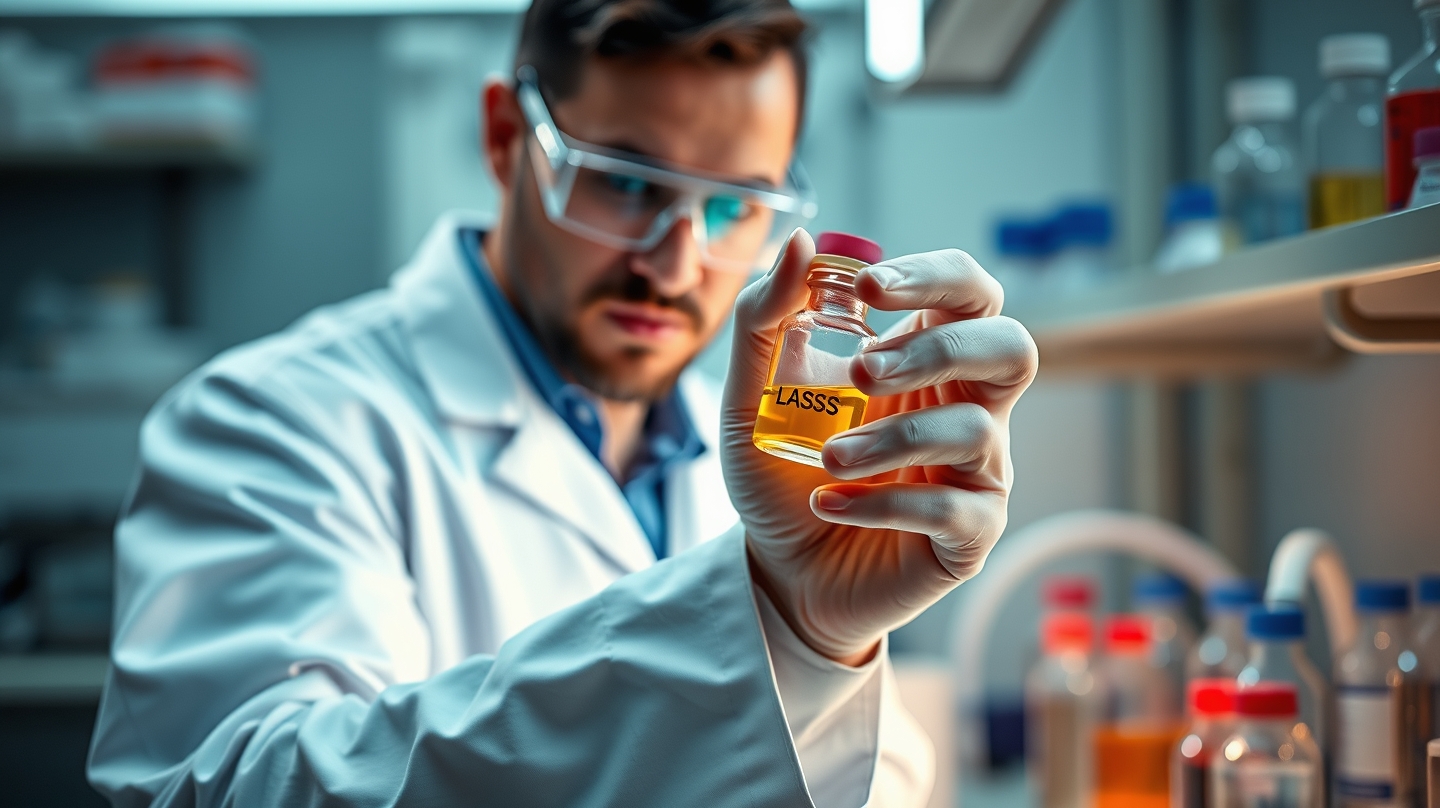
When the body’s natural repair signal, hepatocyte growth factor (HGF), becomes chemically “rusted,” muscle fibers lose the ability to heal efficiently—a problem that accelerates after age fifty. Researchers at Kyushu University have now shown that a sulfur‑rich antioxidant, lipoic acid trisulfide (LASSS), can not only protect HGF from this corrosion but also amplify its binding power, reviving a pathway that many thought was irretrievably weakened.
The study, led by Professor Ryuichi Tatsumi of the Faculty of Agriculture, focused on the nitration of HGF—a modification that adds nitro groups to two critical tyrosine residues (Y198 and Y250). These sites sit at the protein’s “key” region that engages the c‑met receptor on satellite cells, the stem‑like cells responsible for rebuilding damaged muscle. Nitrated HGF behaves like a key that no longer fits its lock, leaving satellite cells dormant and muscle regeneration stalled.
To counteract this, the team tested two trisulfide antioxidants: glutathione trisulfide (GSSSG) and LASSS. Both reduced nitration levels, but only LASSS, when used at a higher molar ratio (1:8000 HGF:trisulfide), doubled the protein’s ability to bind c‑met compared with untreated HGF. In laboratory assays, LASSS‑treated HGF also displayed greater resistance to further oxidative damage, suggesting a dual protective and potentiating effect.
Beyond the biochemical breakthrough, the research highlights how automation and AI‑driven screening are reshaping drug discovery. The investigators employed a high‑throughput platform that rapidly mixed HGF with a library of sulfur compounds, measuring binding affinity in real time. Machine‑learning models then prioritized candidates that showed the strongest functional recovery, allowing LASSS to emerge after only a few iterative cycles. This workflow mirrors a broader industry shift where technology‑enabled pipelines compress years of bench work into months.
For seniors, the implications are concrete. Sarcopenia—the age‑related loss of muscle mass and strength—affects up to 30 % of adults over sixty, driving falls, loss of independence, and rising health‑care costs. Current interventions rely on exercise and protein supplementation, which only partially offset the underlying molecular decline. Restoring HGF signaling with a compound like LASSS could complement lifestyle measures, offering a pharmacological route to preserve fast‑twitch fibers and reduce intramuscular fat infiltration.
Real‑world translation will require safety profiling and formulation work, but the sulfur chemistry of LASSS is already under investigation for other redox‑related conditions, potentially smoothing the regulatory path. Moreover, the study’s open‑source data set invites further computational refinement, encouraging biotech firms to integrate similar antioxidant strategies into pipelines aimed at muscle‑wasting diseases, including cachexia and muscular dystrophies.
In the broader context, the discovery underscores a convergence of biology and technology: a molecular insight paired with automated screening yields a candidate that could alter how the industry approaches age‑related degeneration. As the global population ages, such cross‑disciplinary solutions may become central to both public‑health policy and the commercial biotech landscape.




















