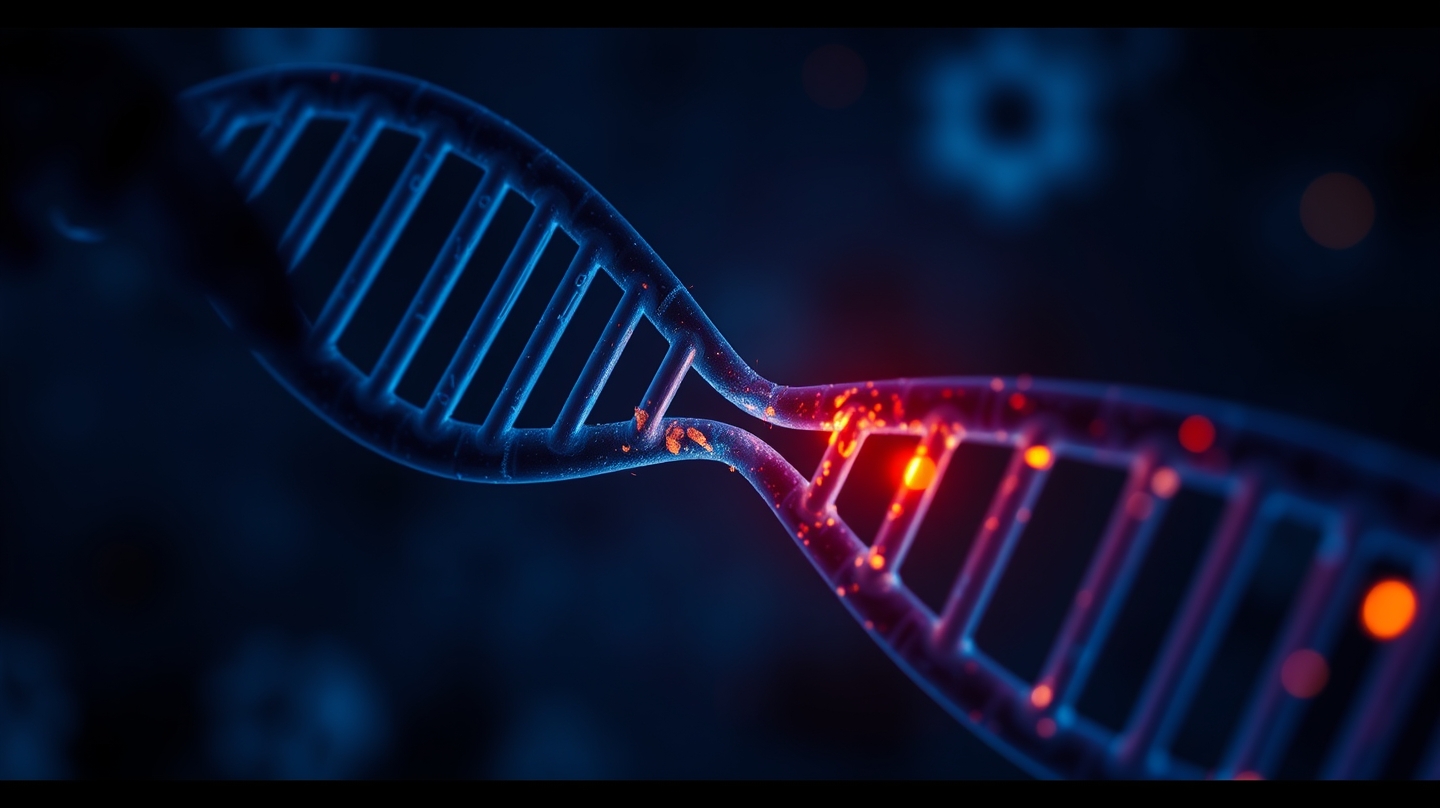
What if the very engines that power a tumor’s relentless expansion also become its Achilles’ heel? New research from the Hebrew University of Jerusalem shows that cancer cells, by over‑driving genetic control hubs called super‑enhancers, generate double‑strand DNA breaks that they must repeatedly repair—a process that seeds further mutations.
Super‑enhancers act like high‑gain amplifiers, cranking up the expression of genes that promote division, survival and metabolic rewiring. The study, led by PhD candidate Osama Hidmi under Prof. Rami Aqeilan, mapped these breaks across dozens of tumor types using a sensitive, automated genome‑wide sequencing pipeline. The resulting maps revealed a striking pattern: breaks clustered precisely where super‑enhancers were most active, not at random locations.
Each break forces the cell’s repair machinery to act. While most repairs restore the double helix, the process is imperfect; tiny insertions, deletions or base‑substitutions can slip in. Over many cycles, these errors accumulate, turning the super‑enhancer region into a mutation hotspot. The authors argue that this self‑inflicted instability fuels tumor evolution, enabling cancer cells to adapt to therapeutic pressure or hostile microenvironments.
The findings matter for three reasons. First, they identify a previously under‑appreciated source of genomic instability that operates independently of classic mutagenic exposures. Second, they expose a potential therapeutic weak point: drugs that block the repair pathways active at super‑enhancers could push cancer cells into lethal genomic chaos. Third, the work showcases how automation and AI‑driven analysis are reshaping biomedical discovery, turning massive sequencing data into actionable insight within days rather than months.
From a technology perspective, the study leveraged high‑throughput sequencing platforms integrated with robotic sample handling and cloud‑based bioinformatics pipelines. This workflow automation reduced hands‑on time, minimized batch effects, and allowed the team to process hundreds of tumor genomes in parallel. Such infrastructure is now a cornerstone of modern oncology research and is spilling over into other sectors, including media companies that use similar pipelines to automate content tagging and recommendation.
Beyond the lab, the discovery could influence how clinicians monitor disease progression. If super‑enhancer‑associated breaks can be detected in circulating tumor DNA, physicians might gain an early warning system for emerging resistance. Moreover, biotech firms are already exploring small‑molecule inhibitors that disrupt super‑enhancer formation, a strategy that could dovetail with existing DNA‑damage response drugs.
In the broader landscape, the work exemplifies a feedback loop between biological insight and technological capability. As sequencing costs fall and automation scales, researchers can interrogate cancer genomes at unprecedented depth, uncovering vulnerabilities that were invisible a decade ago. Conversely, the biological questions drive further innovation in data‑intensive pipelines, reinforcing a cycle of discovery and tool development.
Ultimately, the study reframes cancer’s aggressiveness not merely as a symptom of uncontrolled growth but as a consequence of the cell’s own attempt to sustain that growth. By breaking its own DNA, a tumor creates both risk and opportunity—risk of collapse under repair overload, opportunity for scientists to intervene with precision therapies.




















