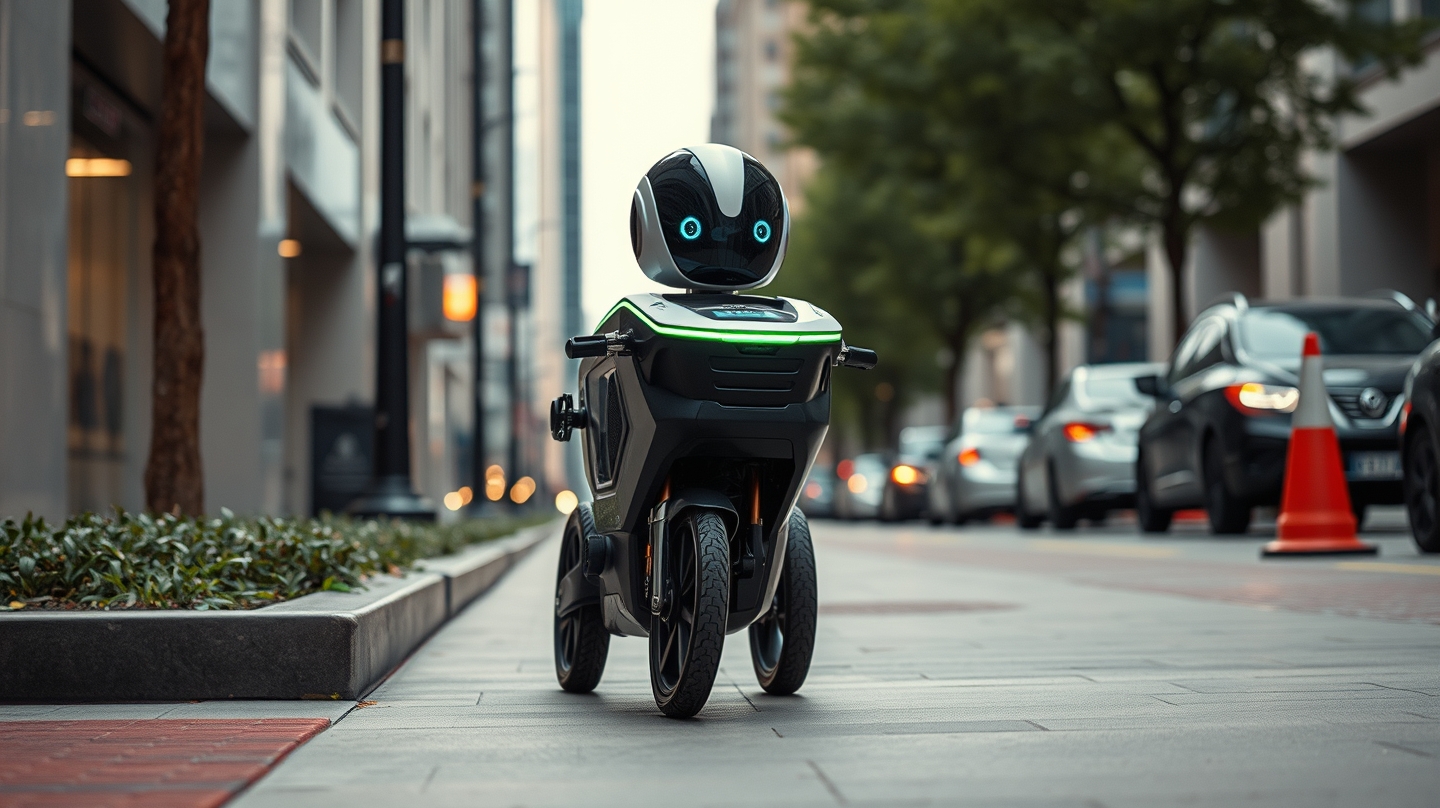
Every day, hundreds of Avride’s sidewalk robots glide through bustling city avenues, handling pedestrians, traffic lights and narrow lanes with little human input. Yet the true test of autonomy lies not in routine maneuvers but in rare, high‑stakes moments—an active crime scene, an emergency vehicle, or freshly poured cement that looks like ordinary pavement. To bridge that gap, Avride has paired its on‑board perception stack with a cloud‑based vision‑language model (VLM) that acts as an automated early‑warning system.
The VLM, dubbed the “VLM‑watcher,” does not steer the robot in real time. Instead, it receives anonymized image snapshots from the robot every few seconds, processes them in a heavyweight cloud model, and returns a semantic description of the scene. If the description matches predefined high‑risk patterns—such as a police officer near a crowd, a firetruck on a blocked street, or wet cement that could cause a slip—the system tags the frame and alerts a remote assistance team. Human operators can then intervene, reroute the robot, or pause its mission, all while preserving the low‑latency safety of the local navigation stack.
This architecture solves a fundamental limitation of on‑board models. Local neural networks excel at detecting individual objects—cyclists, children, wheelchairs—but they lack the broader context required to infer intent or situational severity. A VLM, trained on billions of image‑text pairs, can interpret how multiple entities interact, recognize subtle cues like a police officer’s uniform combined with a taped‑off area, and generate a concise natural‑language summary for human reviewers.
Why does this matter? Autonomous delivery promises faster, contact‑free logistics, yet public acceptance hinges on safety in unpredictable environments. By adding a cloud‑based semantic guard, Avride reduces the risk of robots inadvertently entering emergency zones or causing accidents on newly laid surfaces. The approach also respects privacy: faces and license plates are blurred on the device before any data leaves the robot, ensuring compliance with emerging data‑protection regulations.
Beyond safety, the VLM‑watcher illustrates a broader industry shift toward hybrid autonomy—combining edge intelligence with cloud‑scale reasoning. Companies that rely solely on on‑board perception may struggle with edge cases that require world knowledge or temporal reasoning. Cloud models can ingest updates instantly, adapt to new regulations, and incorporate feedback from human operators without redeploying firmware to every robot.
From a structural standpoint, Avride’s system creates a feedback loop: on‑board sensors feed raw data upward, the VLM interprets context, and human operators feed corrective actions back down. This loop not only improves immediate safety but also generates a labeled dataset for future on‑device model training, gradually shifting more understanding to the edge and reducing dependence on constant connectivity.
Real‑world implications are already emerging. In a pilot in Austin, Texas, a robot received a VLM‑generated alert when a construction crew placed wet cement across a sidewalk. The remote team rerouted the robot, avoiding a potential slip hazard and preserving the delivery schedule. In another case, a VLM tag identified a crowd gathering for a protest, prompting the robot to pause and wait for clearance, thereby preventing a possible confrontation.
Avride’s strategy aligns with a growing consensus that safety‑critical AI must be layered, transparent, and human‑in‑the‑loop. As more municipalities draft ordinances for autonomous delivery, the ability to demonstrate proactive risk mitigation could become a competitive differentiator. Moreover, the model’s reliance on language prompts makes it adaptable: new tags can be added for emerging scenarios—such as pandemic‑related signage or climate‑related road closures—without rewriting low‑level code.
In sum, the integration of cloud vision‑language models offers a pragmatic path forward for autonomous delivery fleets: it preserves the speed of edge navigation while borrowing the depth of cloud AI to interpret complex, high‑stakes environments. The result is a more trustworthy service that can scale across cities with diverse, ever‑changing streetscapes.




















