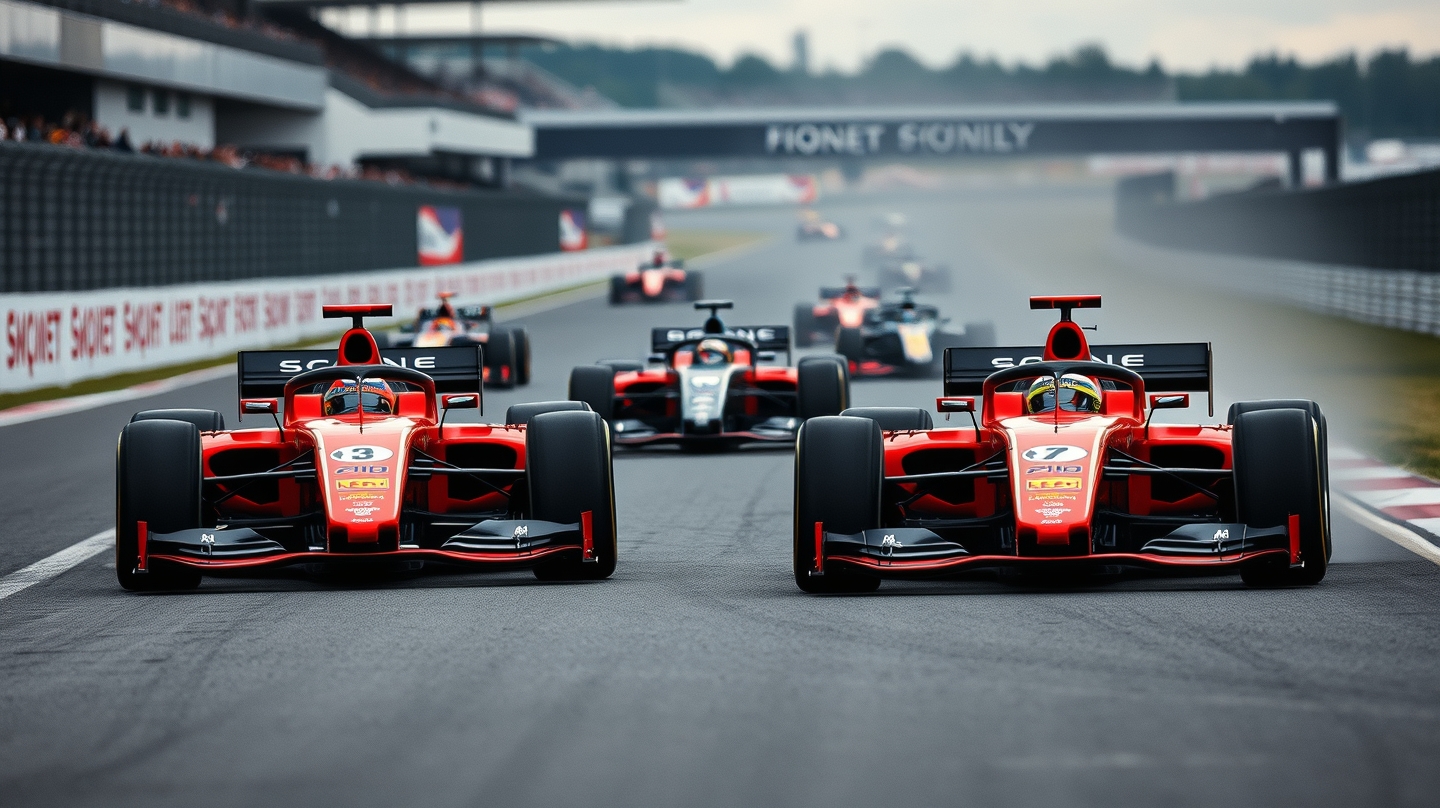
The British Grand Prix is just around the corner, and Lewis Hamilton is warning fans that this year's event will be 'completely different' due to the new cars. The Silverstone track, renowned for its challenging high-speed corners, will pose a unique set of challenges for drivers as they navigate the circuit with reduced power.
According to Hamilton, the lack of braking points on the track means that the cars will be 'energy starved', resulting in reduced power output from the engines. This will force drivers to adapt their driving style, with Hamilton predicting that the cars will be running with 'not much more than half the engines' full power' at key points on the track.
The Ferrari driver explained that the cars will be recovering energy through the high-speed corners of Copse and Becketts, but the batteries will run out before the end of some sections, leaving the cars to rely on the internal combustion engines alone. This will result in a significant reduction in power, with Hamilton estimating that the deficit could be 'twice as big' as it was in the Austrian Grand Prix.
Other drivers, including Fernando Alonso and George Russell, have also weighed in on the issue, with Alonso describing the lack of power as a 'challenge' and Russell suggesting that it could lead to more exciting racing. However, Russell also noted that the problem is exacerbated by the FIA's decision not to allow straight-line mode on certain sections of the track, which was made for safety reasons.
The impact of the new cars on the British Grand Prix is just one example of the technological advancements that are transforming the sport of Formula 1. As the industry continues to evolve, we can expect to see more innovations and changes that will shape the future of the sport.
In terms of the wider implications, the adoption of new technologies in Formula 1 has the potential to drive innovation and improvement in other areas, such as automotive and aerospace engineering. The use of advanced materials, sophisticated computer simulations, and cutting-edge manufacturing techniques are just a few examples of the ways in which the sport is pushing the boundaries of what is possible.
As the British Grand Prix approaches, fans will be eager to see how the new cars perform on the iconic Silverstone track. With the reduced power output and the unique challenges posed by the circuit, it promises to be an exciting and unpredictable event. Whether you're a die-hard Formula 1 fan or just interested in the latest technological advancements, this year's British Grand Prix is not to be missed.




















