The City's Quiet Revolution
Shenzhen has been humming the same industrial lullaby for decades, its skyline a chorus of steel and glass. Yet in the middle of that chorus a new melody has emerged: a place where walls are not barriers but canvases, where the day begins not with a bell but with the rustle of paper and the scent of rain on bamboo.
A Classroom Without Ceilings
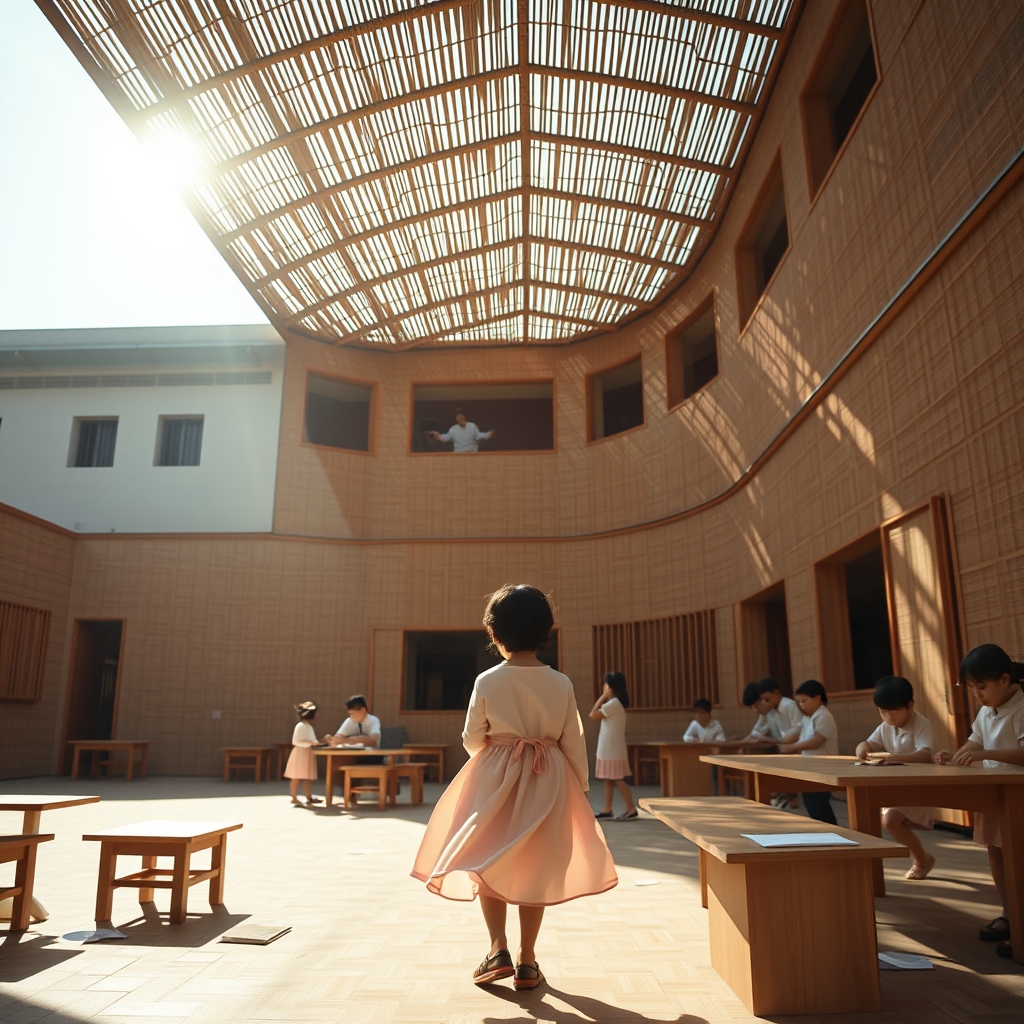
Wuzhou Primary School cradles its children beneath a roof of translucent panels that catch the afternoon light like a watercolor wash. The floors are a soft, reclaimed timber that yields a gentle sigh under bare feet. Here, learning is not a sequence of lectures but a series of pauses—moments when a child lifts a paint‑splattered brush, when a group gathers around a spiraled staircase to map a dream of flying machines.
Design as Pedagogy
The architects treated curiosity as structural support. Curving corridors invite wandering, and every nook hides a surprise: a pocket of moss, a hanging garden of succulents, a wall of glass that reflects the city's neon in a muted glow. In one alcove, a wooden desk doubles as a stage; a child steps up, breathes in the cool air, and recites a poem that feels like an oath to the future.
Fashion Meets Function
Even the uniforms echo this ethos. Cut from breathable linen, dyed in muted earth tones, they move with the body rather than constrain it. A child slipping a hand through the hem feels the fabric's whisper, an echo of the building's own soft murmur. The clothing becomes a second skin, a subtle statement that creativity is not an accessory but an essential layer.
Quiet Revelation
One afternoon, while watching a group of six‑year‑olds trade sketches of imagined cities, I realized that the school's true lesson is not about mathematics or literacy. It is about the permission to imagine. In that shared silence, a boy traced a line across his paper and said, "If we build what we dream, the city will remember us." The words lingered like the after‑taste of jasmine tea, a reminder that space can nurture the most radical of rebellions—being oneself.
Shenzhen's shift from factories to futures is not written in policy papers alone; it is etched in the gentle arc of a bamboo wall, in the laugh that rolls across a sunlit courtyard, in the way a child's silhouette merges with the architecture that raised them. This school is a quiet manifesto, a living proof that when design honors play, the city itself begins to play.