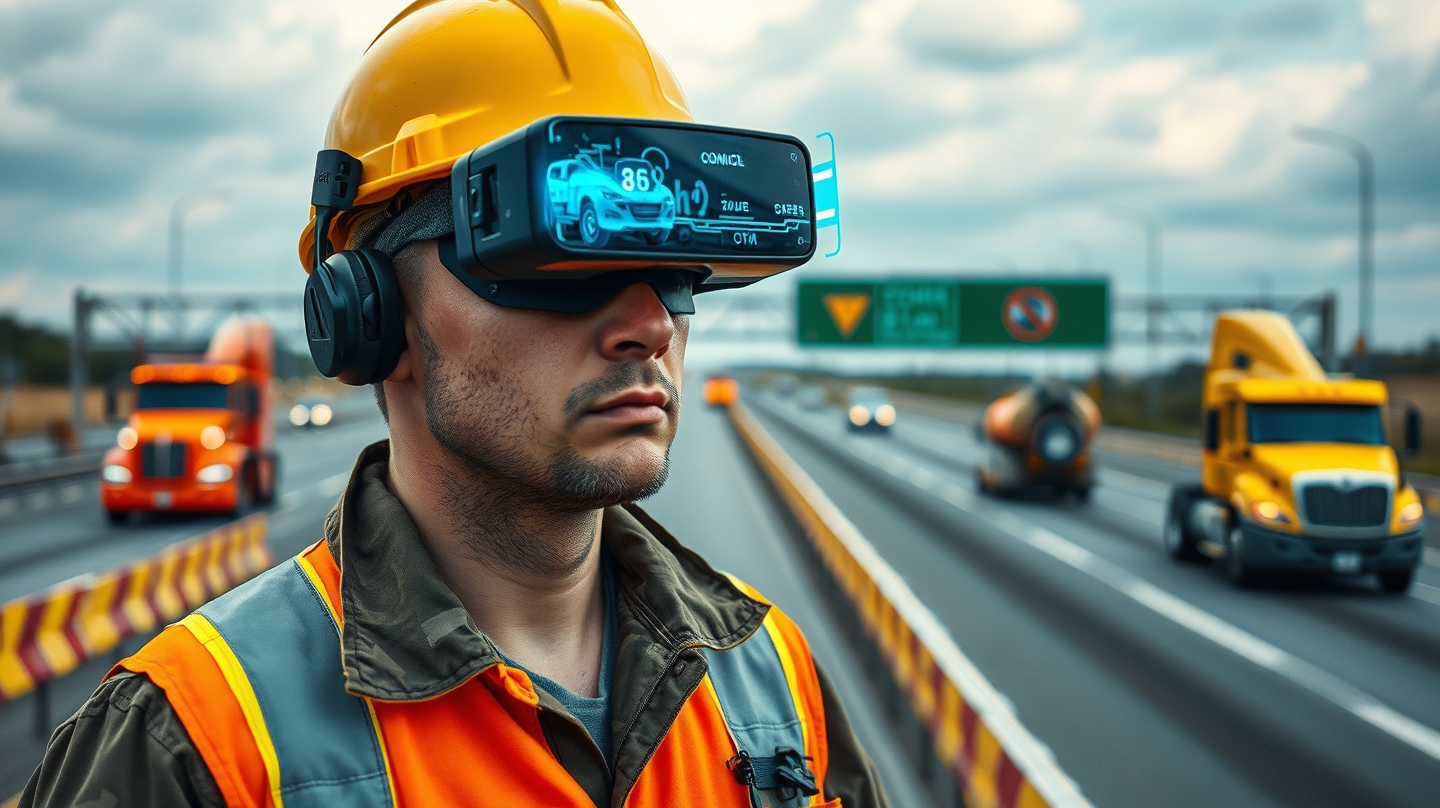
Every day, crews repair highways while traffic roars past, creating a constant hazard that can blur into the background. The statistics are stark: between 2011 and 2021, struck‑by incidents on road work zones claimed roughly 1,800 lives and caused more than 167,000 non‑fatal injuries, according to the National Institute for Occupational Safety and Health (NIOSH). Researchers at Texas A&M University believe artificial intelligence could turn that trend around by keeping workers’ attention sharp and delivering site‑specific safety cues in real time.
Assistant professor Namgyun Kim, who leads the construction‑science lab at Texas A&M, teamed up with colleague Brian Anderson and LSU researcher Yongcheol Lee to explore how AI and virtual reality (VR) can reshape safety training. Their approach blends four strands: immersive VR simulations that mimic real‑world hazards, brain‑activity monitoring to gauge focus, field observations of actual work zones, and AI‑driven augmented reality (AR) overlays that flag danger as it emerges.
“Construction has long been seen as low‑tech, but the adoption of Building Information Modeling already proved that digital tools can cut errors and improve outcomes,” Kim told Construction Dive. “AI is the next logical step—it can predict a vehicle’s trajectory, detect a worker’s position, and alert both before a collision occurs.”
The research addresses a key limitation of existing VR safety programs: static scenarios. Traditional VR training offers a set of pre‑programmed situations, which rarely capture the unique mix of traffic flow, site geometry, and crew behavior found on any given project. By feeding live sensor data into machine‑learning models, the team creates dynamic simulations that evolve with the site, allowing workers to practice responses that mirror their actual environment.
In pilot tests, workers who completed AI‑enhanced training identified hazards 30 % faster than those who received conventional classroom instruction. Moreover, the AR system projected visual warnings—such as a highlighted vehicle path—directly onto a worker’s headset, reducing the need to glance away from the task at hand. The technology also logs each alert, giving supervisors actionable metrics on near‑miss events.
Beyond safety, the researchers highlight a clear return on investment. Fewer struck‑by incidents translate into lower workers’ compensation costs, fewer project delays, and improved morale. Industry analysts estimate that every dollar spent on proven safety technology can save up to $4 in downstream expenses, a figure that aligns with the team’s early cost‑benefit analysis.
Adoption hurdles remain. CEOs often view VR and AI as experimental, despite a decade of academic validation. Kim argues that the market now offers commercial VR platforms ready for integration, and that the next step is scaling AI models to accommodate the variability of each job site. “It’s no longer a question of whether the technology works, but how quickly firms can embed it into daily routines,” he said.
The broader implication is a shift in construction culture—from reactive safety measures to proactive, data‑driven prevention. As AI continues to mature, similar systems could monitor equipment health, optimize traffic sequencing, and even suggest alternative work‑zone layouts to minimize exposure. The ripple effect may extend to policy, prompting regulators to incorporate AI‑generated safety records into compliance frameworks.
For workers on the ground, the promise is simple: an extra layer of awareness that could mean the difference between a routine day and a tragedy. For the industry, it represents a measurable step toward reducing the human cost of infrastructure development.