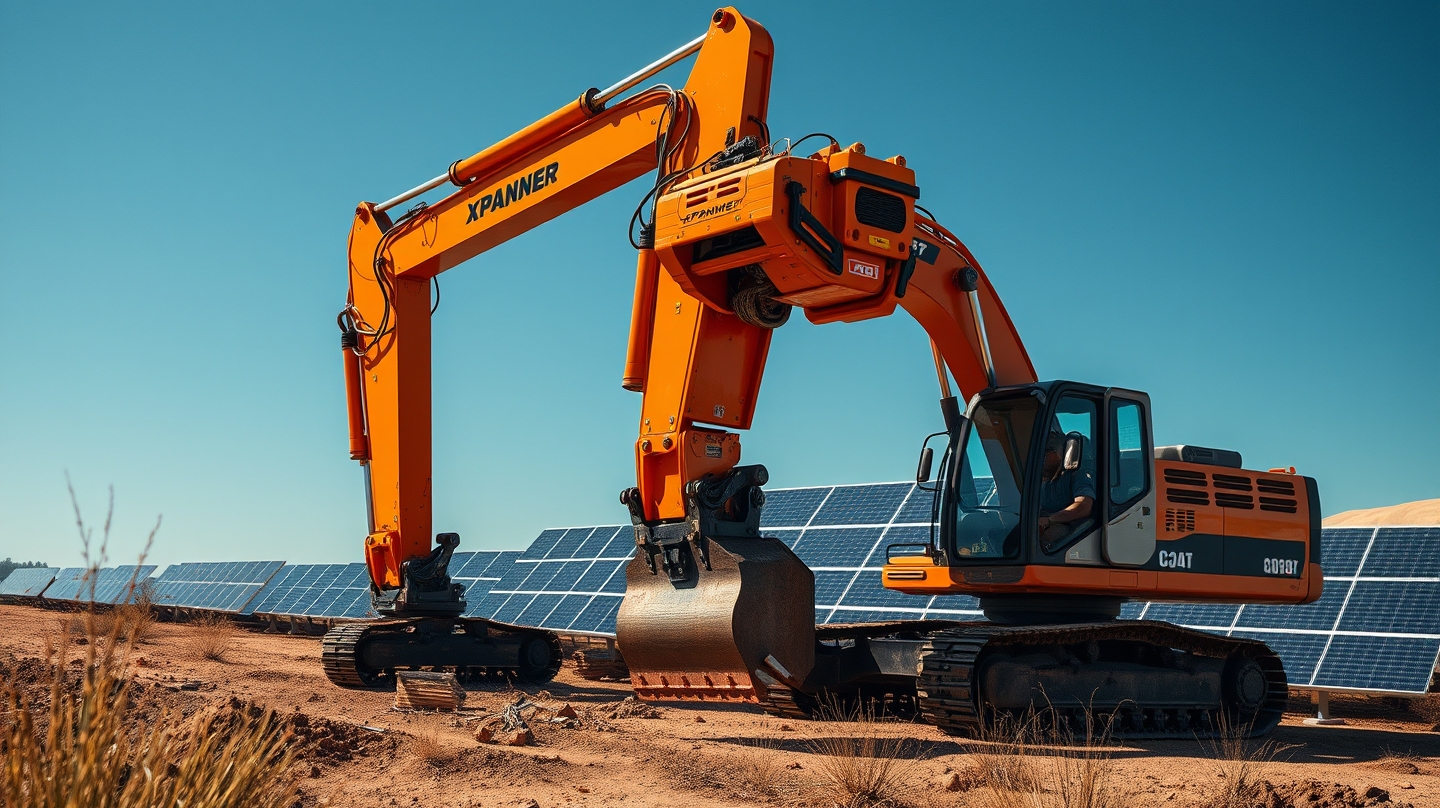
Utility‑scale solar farms have long relied on dozens of skilled workers to carry, align and bolt heavy modules across acres of terrain. Yesterday, Xpanner Global unveiled a robot that can lift and place those panels with a single button press, raising the question of whether massive crews will become a relic of the past.
The X1 Panel Lift is built on a standard excavator chassis but adds a proprietary Mango controller that fuses lidar, vision and GNSS data into a live 3‑D model of the jobsite. This sensor stack gives the system situational awareness, allowing it to suction a panel, swing it into position and release it with millimetre precision. An operator controls the entire sequence from outside the cabin, and the robot can handle two adjacent rows at once, meaning a three‑person crew can maintain a full workflow instead of the ten‑plus workers traditionally required.
Labor scarcity has become a bottleneck for solar developers, especially as projects scale to gigawatt levels. By automating the repetitive material‑handling step, the X1 Panel Lift promises faster installation cycles, reduced overtime costs and a tighter safety envelope. Panels are still bolted manually, but the most physically demanding lift is now performed by a machine that can operate from day one without extensive re‑training.
The launch reflects a broader shift toward physical AI in construction. Xpanner’s platform treats automation as a software layer that can be retrofitted onto existing equipment, sidestepping the capital expense of buying brand‑new robots. Future updates could extend the same architecture to tasks such as trenching or concrete placement, illustrating how a single hardware foundation can support multiple workflows through code.
Xpanner is offering the X1 Panel Lift through an all‑inclusive subscription that bundles the hardware kit, the Mango controller license, a cloud‑based Xpanner Connect dashboard and on‑site field‑operations support (XFO). This model lowers the upfront barrier for developers and provides continuous performance monitoring, a feature that aligns with the industry’s move toward data‑driven project management.
As solar construction embraces automation, the competitive advantage will shift from sheer manpower to the ability to deploy adaptable, software‑centric machines. Xpanner’s approach suggests that the next wave of solar farms may be built by a handful of operators overseeing fleets of intelligent excavators, accelerating the transition to clean energy while easing the pressure on a dwindling skilled‑labor pool.