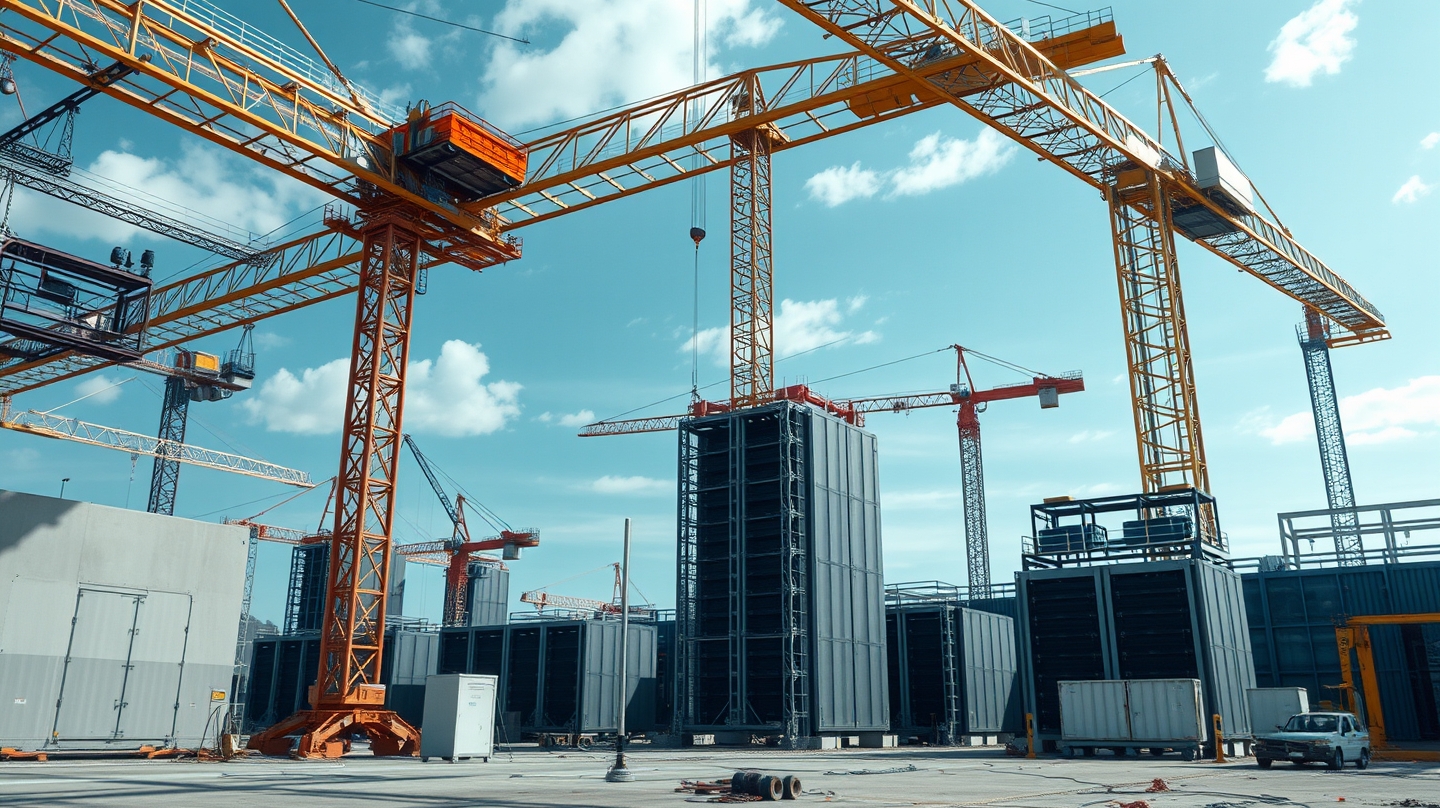
June’s construction outlook cooled just as data center builders hit a rare brake, leaving a mixed picture for the sector. The Dodge Momentum Index (DMI), which tracks non‑residential projects entering the planning stage, slipped 1.9% month‑over‑month, ending a streak of two gains.
Sarah Martin, director of economic research at Dodge Construction Network, explained that the dip stems largely from a “tap on the brakes” around data center planning. "Data center activity continued to drive the index, but its pace moderated from the extraordinary levels seen in recent months," she said. While the overall index fell, the broader commercial and institutional segments still posted solid year‑over‑year growth, underscoring a nuanced market dynamic.
Commercial planning, which includes data center work, dropped 6.8% in June. Yet, almost every other sector within the commercial category posted gains. Traditional office buildings, warehouses, retail stores and hotels each recorded modest month‑over‑month increases, and institutional projects—spanning healthcare and education—jumped 10.9%.
From a year‑over‑year perspective, the DMI and its sub‑segments remain well ahead of 2025 levels, with a 21.8% gain compared to June 2025. Without the data‑center component, the commercial segment would have risen only about 7.6% year‑over‑year, highlighting how pivotal large‑scale tech projects have become to construction pipelines.
June also saw 59 projects valued at $100 million or more enter planning. The marquee data center projects included the $500 million Stak Energy AI campus in Prudhoe Bay, Alaska; the $480 million Project Swan complex in Lakeland, Florida; and the $456.8 million Parcel A data center in Manassas, Virginia. Institutional highlights featured the $437 million DCSO Correctional Facility in Nashville, Tennessee, a $320 million Cone Health Hospital in Winston‑Salem, North Carolina, and a $303 million El Camino Health Hospital in Los Gatos, California.
These figures illustrate a broader shift: technology‑driven automation and workflow transformation are reshaping construction demand. Data centers, once niche, now anchor multi‑billion‑dollar projects that require specialized mechanical, electrical, and plumbing (MEP) systems, high‑density power distribution, and advanced cooling solutions. The recent slowdown suggests developers are reassessing capacity needs amid rising operational costs and a maturing AI market.
For the construction industry, the implication is twofold. First, firms that have invested in automation‑ready labor forces and digital design tools stand to capture the remaining demand for high‑tech infrastructure. Second, the modest rebound in traditional sectors signals a rebalancing, where developers return focus to office retrofits, warehouse expansions, and health‑care facilities—areas less vulnerable to rapid tech‑cycle volatility.
From a policy standpoint, the data underscores the importance of aligning permitting processes with the unique timelines of data‑center projects. Faster approvals could mitigate the “brake” effect, while targeted incentives for energy‑efficient designs may sustain momentum without inflating costs.
Overall, June’s mixed results reveal that while the data‑center surge has cooled, its influence on construction planning remains significant. Stakeholders—from developers to policymakers—must monitor how automation and media‑infrastructure demands evolve, ensuring that the sector can adapt without sacrificing the growth seen in other commercial and institutional domains.