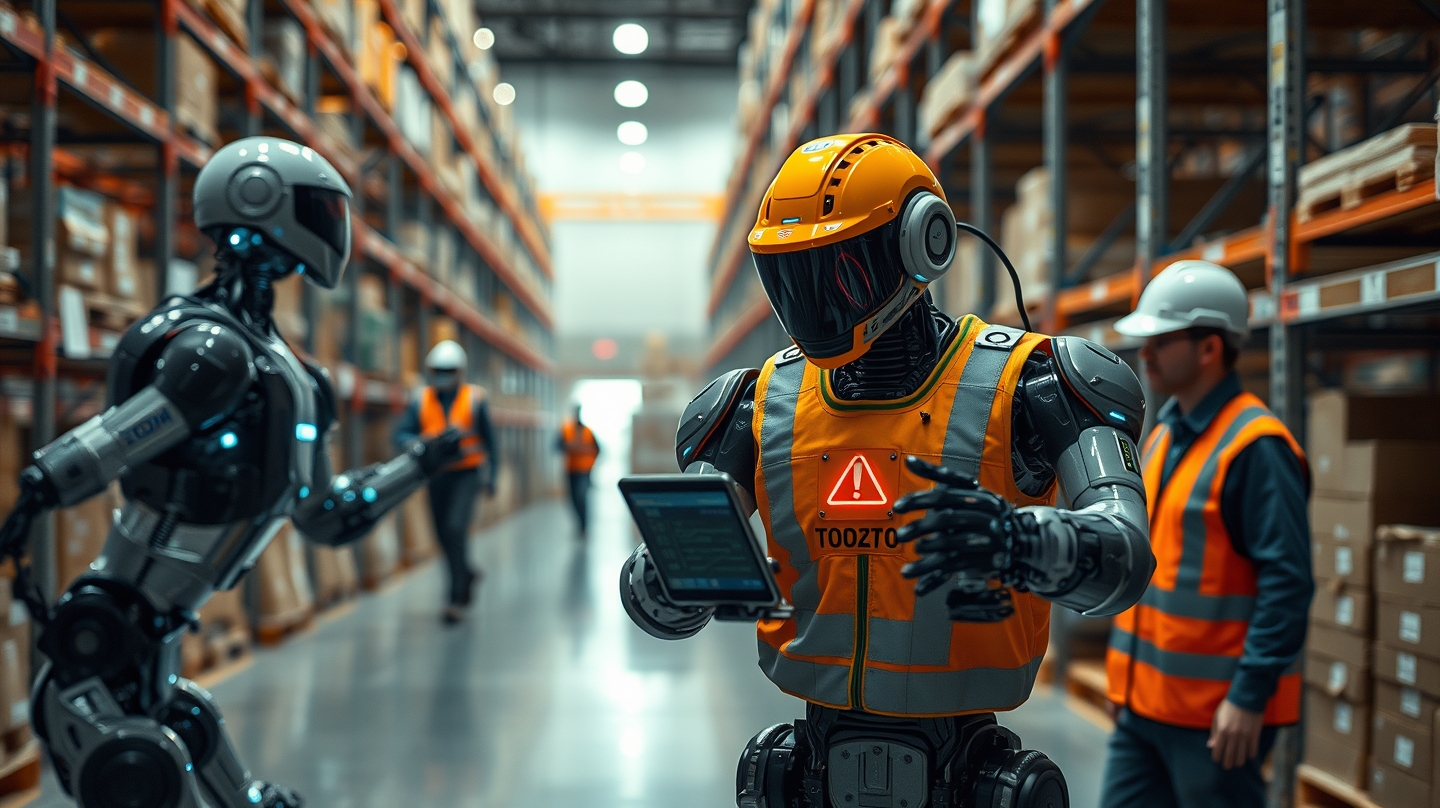
Warehouse managers are caught between two competing imperatives: accelerate robot adoption to meet rising e‑commerce demand, and keep human workers safe when fleets of autonomous machines share the same floor. The tension spikes whenever a safety protocol forces a full‑fleet shutdown, costing minutes—or even hours—of productivity. A free webinar on August 26 will unpack how to reconcile compliance with continuous operation, offering a roadmap that could keep both robots and people moving.
The virtual session, titled “When Robots and People Share the Floor: Safety That Keeps Fleets Moving,” brings together technology providers and logistics experts to dissect real‑world challenges. Panelists will walk attendees through risk‑assessment methods for expanding fleets of Automated Guided Vehicles (AGVs), Autonomous Mobile Robots (AMRs) and autonomous forklifts. They will also discuss integration with Automated Storage and Retrieval Systems (ASRS), the hidden productivity penalties of outdated safety practices, and newer collision‑avoidance techniques that protect associates without halting the entire line.
At the heart of the discussion is Redpoint Positioning’s Crew Safety System, a SIL2/PLd‑certified solution that lets technicians intervene on active robots without triggering a plant‑wide stop. John Calcio, Redpoint’s vice‑president of partnerships, will explain how ultra‑wideband (UWB) location data creates a “virtual safety bubble” around workers, enabling precise, real‑time alerts while preserving throughput. The system’s certification under IEC 61508 and ISO 13849‑1 gives it a regulatory edge that many legacy safety layers lack.
John Santagate, founder of EMP Advisors and former senior vice‑president of global robotics at Infios, will add a vendor‑neutral perspective. He will outline how organizations can evaluate safety‑first technology stacks, balance ROI against compliance costs, and avoid the common pitfall of retrofitting safety after a fleet is already in place. Santagate’s experience across retail, manufacturing and logistics gives him a panoramic view of how safety decisions ripple through supply‑chain performance.
Geek+’s Jonathan Cortellacci will close the panel with a case study on how a large North‑American distribution center used data‑driven safety analytics to cut robot‑human incidents by 40 % while increasing pick‑rate capacity by 15 %. The example illustrates that safety need not be a bottleneck; instead, it can be a lever for operational agility.
Why does this matter? As the logistics sector leans heavily on automation to meet same‑day delivery expectations, even a single safety‑related stoppage can erode service levels and inflate labor costs. Moreover, regulators are tightening standards around collaborative robotics, meaning non‑compliant fleets risk fines or forced shutdowns. By adopting certified, data‑rich safety layers now, firms can future‑proof their operations and maintain a competitive edge.
The webinar also highlights a broader industry shift: moving from reactive, rule‑based safety checks to proactive, sensor‑fusion approaches that predict collisions before they happen. This evolution mirrors trends in other high‑risk domains such as autonomous driving and industrial IoT, where real‑time situational awareness is becoming the baseline for safe operation.
Attendees will leave with a concrete checklist for scaling robot fleets safely, a list of vetted technology partners, and access to a recorded session for on‑demand reference. Registering now ensures a spot in a live Q&A where participants can pose site‑specific questions to the panel.