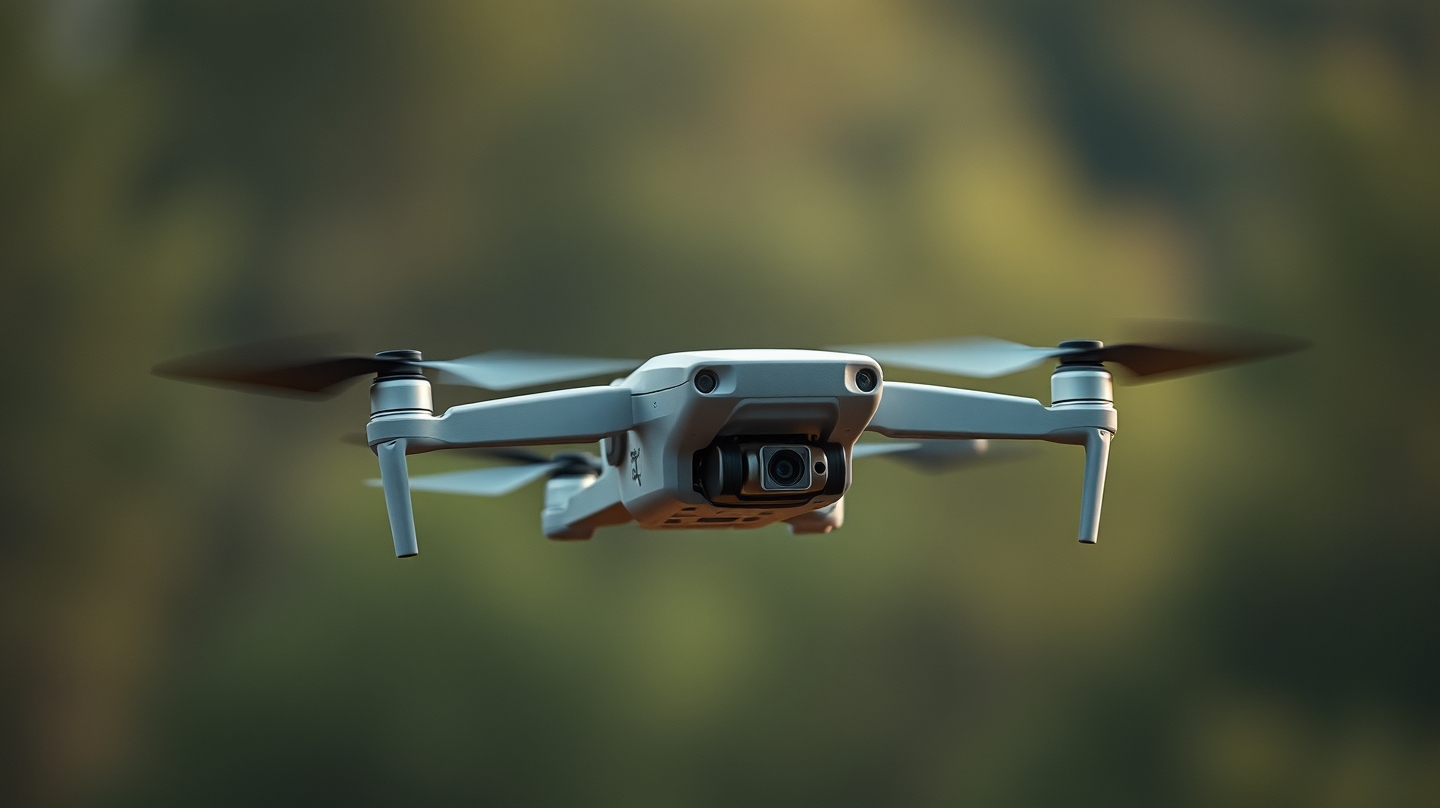
When a quadrotor buzzes overhead, most people instinctively look away; the whine and the clumsy wobble make drones hard to ignore. This week, researchers from Northwestern University turned that expectation on its head by presenting a prototype that is deliberately hard to see. At the RSS 2026 conference in Sydney, the team unveiled the Phantom Twist, a spinning drone that exploits the limits of human visual perception to appear as a faint smear rather than a solid object.
The secret lies in speed. By rotating its frame at 15–25 Hz, the drone forces the eye’s 100‑millisecond integration window to average the rapidly moving parts with whatever lies behind them. The result is a phenomenon known as persistence of vision, where the moving structure blends into the background and the observer perceives only a translucent streak. The design is not merely a gimmick; most of the airframe consists of empty carbon‑fiber rods, reducing the visual mass that must be blurred.
Controlling a single‑motor, constantly rotating platform is a technical puzzle. Northwestern’s Michael Rubenstein explains that the motor itself becomes the only actuator. By modulating thrust at precise points in each rotation, the drone can generate lateral forces, allowing translation in any direction. Altitude is managed by overall thrust, while the rapid spin provides passive stability. Optical‑tracking tags on the frame give external motion‑capture systems the data needed for fine‑grained control during testing.
Beyond the novelty, the Phantom Twist raises practical questions for industries that rely on aerial robotics. In inspection and mapping, reduced visual signature could allow drones to operate closer to wildlife or in crowded public spaces without causing disturbance. Conversely, the same invisibility could be leveraged for covert surveillance, prompting regulators to reconsider privacy frameworks that currently assume a visible aircraft.
The project also showcases the power of computational design. Rubenstein describes the design space as “high dimensional,” with trade‑offs between structural rigidity, motor torque, and visual profile. Traditional engineering relies on intuition to navigate such spaces; here, an optimization algorithm evaluated thousands of configurations, selecting the geometry that minimized visual detectability while preserving flight stability. This approach signals a broader shift toward algorithm‑driven hardware that balances performance with human‑centric criteria.
From an automation perspective, the drone’s simplicity—one motor, no moving control surfaces—reduces part count and potential failure modes. That could translate into lower maintenance costs for fleets used in logistics or agriculture, where large numbers of inexpensive units are preferred. The ability to launch the vehicle from a handheld device, as demonstrated in the conference video, further lowers the barrier to rapid deployment in emergency response scenarios.
Media infrastructure may also feel the ripple. The research was highlighted by IEEE Spectrum, underscoring how academic breakthroughs quickly enter public discourse. As visual‑media platforms prioritize novel, shareable content, a drone that “disappears” offers a compelling narrative hook, potentially accelerating adoption in film and advertising where unobtrusive aerial shots are prized.
Ultimately, the Phantom Twist is a reminder that invisibility does not require cloaking materials; it can be achieved through clever exploitation of human perception. Whether that leads to quieter skies, new privacy debates, or more efficient automation will depend on how regulators, manufacturers, and end‑users choose to integrate the technology.