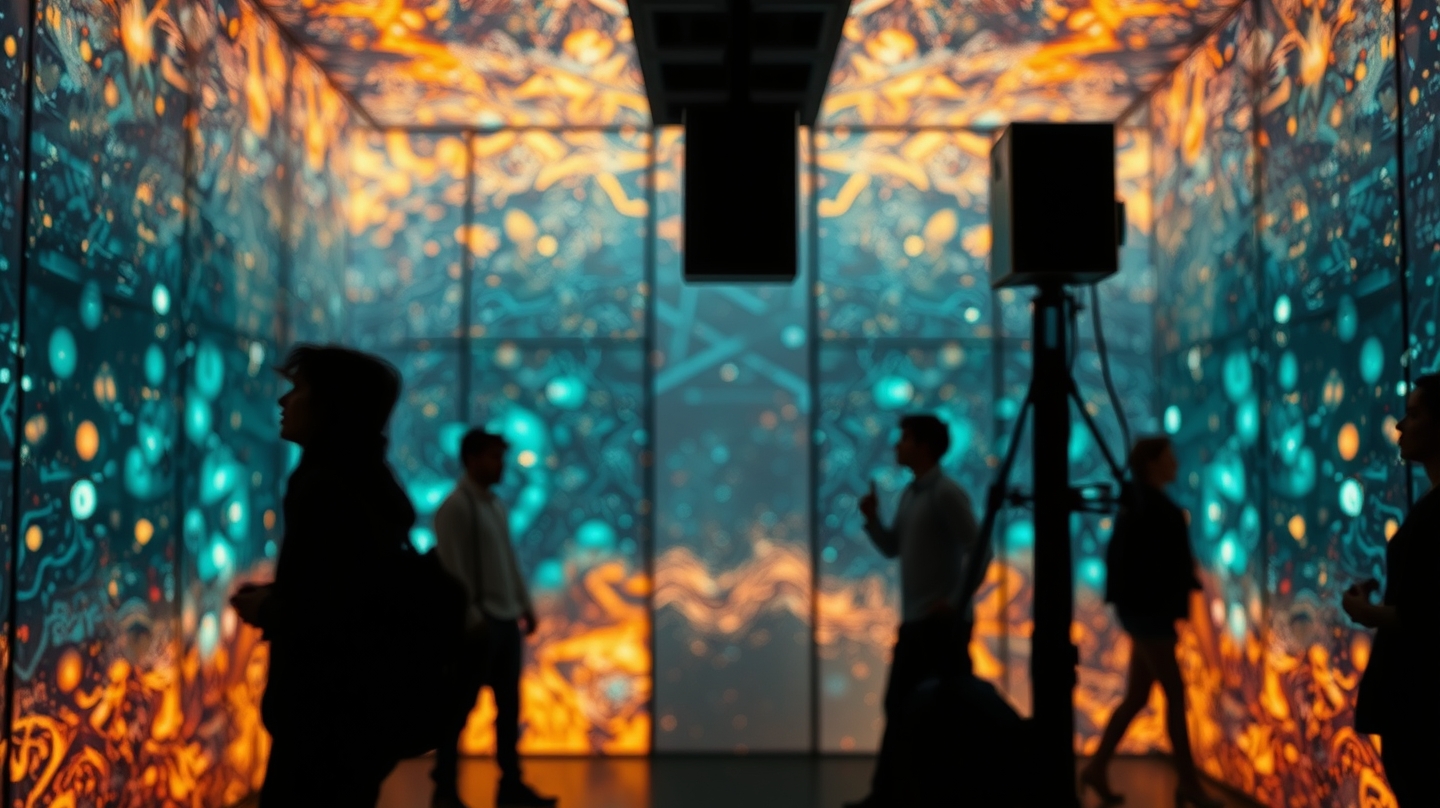
When the lights dimmed at The Grey Box in Kuala Lumpur, visitors were greeted not by static paintings but by a cascade of AI‑generated imagery that shifted with every footstep. The opening of “Algorithmic Organisms 2.0,” a Dutch‑led immersive exhibition, revealed a digital ecosystem that breathes, mutates, and responds to its audience, blurring the line between observer and participant.
Curated by the Jazzy Group of Companies and presented by MAISEAT, the installation is backed by the National Art Gallery of Malaysia and the Dutch Embassy. Dutch audiovisual artist Ray Tijssen, known professionally as 0010×0010, designed the experience to fuse generative visuals, spatial audio, and algorithmic behavior into a single, evolving environment. Over the next month, the work will run daily until July 19, inviting the public to walk through a space where AI‑driven “digital lifeforms” continuously rewrite their own visual narrative.
“We wanted to move beyond the passive museum model,” said Joanne Goh, founder and CEO of Jazzy Group, during the ribbon‑cutting ceremony. “The audience becomes part of the code, influencing how the artwork lives and breathes.” Goh’s remarks underscore a broader ambition: to position Malaysia as a hub where technology and culture intersect, and to spark dialogue about how automated systems can shape creative processes.
The technical backbone relies on generative adversarial networks that produce new visual motifs in milliseconds, while a spatial sound engine maps those motifs to an immersive audio field. As visitors move, motion sensors feed data back into the algorithm, prompting the system to alter colour palettes, textures, and soundscapes in real time. This feedback loop creates a structural insight into how automated workflows can respond to human input without pre‑programmed scripts—a concept that resonates far beyond the gallery walls.
For the local creative industry, the exhibition offers a tangible case study of automation in practice. Film studios, advertising agencies, and game developers in Southeast Asia are already experimenting with AI‑assisted pipelines to accelerate content creation. By witnessing a fully realized, AI‑curated environment, professionals can assess the practical limits and opportunities of such tools, from reducing manual rendering time to generating adaptive narratives for interactive media.
The show also ties into Malaysia’s upcoming Malaysia International Film Festival (MIFFest) 2026, where “Algorithmic Organisms 2.0” was first announced as a sidebar installation. Its presence signals a shift in festival programming toward hybrid experiences that blend traditional screenings with immersive tech showcases. This trend mirrors a global movement where festivals are leveraging AI to personalize audience recommendations, streamline subtitling, and even co‑create visual content with filmmakers.
Beyond the arts, the exhibition raises questions about the societal impact of autonomous systems. If an algorithm can continuously reshape an environment based on sensor data, similar mechanisms could be applied to smart cities, retail spaces, or public safety monitoring. The real‑world implication is clear: as AI becomes more adept at interpreting and reacting to human behavior, industries must grapple with issues of transparency, bias, and ethical governance.
Ray Tijssen will extend the conversation on July 4 with a masterclass titled “Machine Vision & Human Expression” at the National Art Gallery. The session aims to demystify the technical workflow behind the exhibition, offering a rare glimpse into the code, hardware, and artistic decisions that make the living installation possible.
“Algorithmic Organisms 2.0” is not just a showcase of cutting‑edge visuals; it is a laboratory for testing how automated creativity can coexist with human intention. As Kuala Lumpur watches the digital organisms evolve, the city may find itself at the forefront of a new era where art, technology, and everyday life intersect in real time.