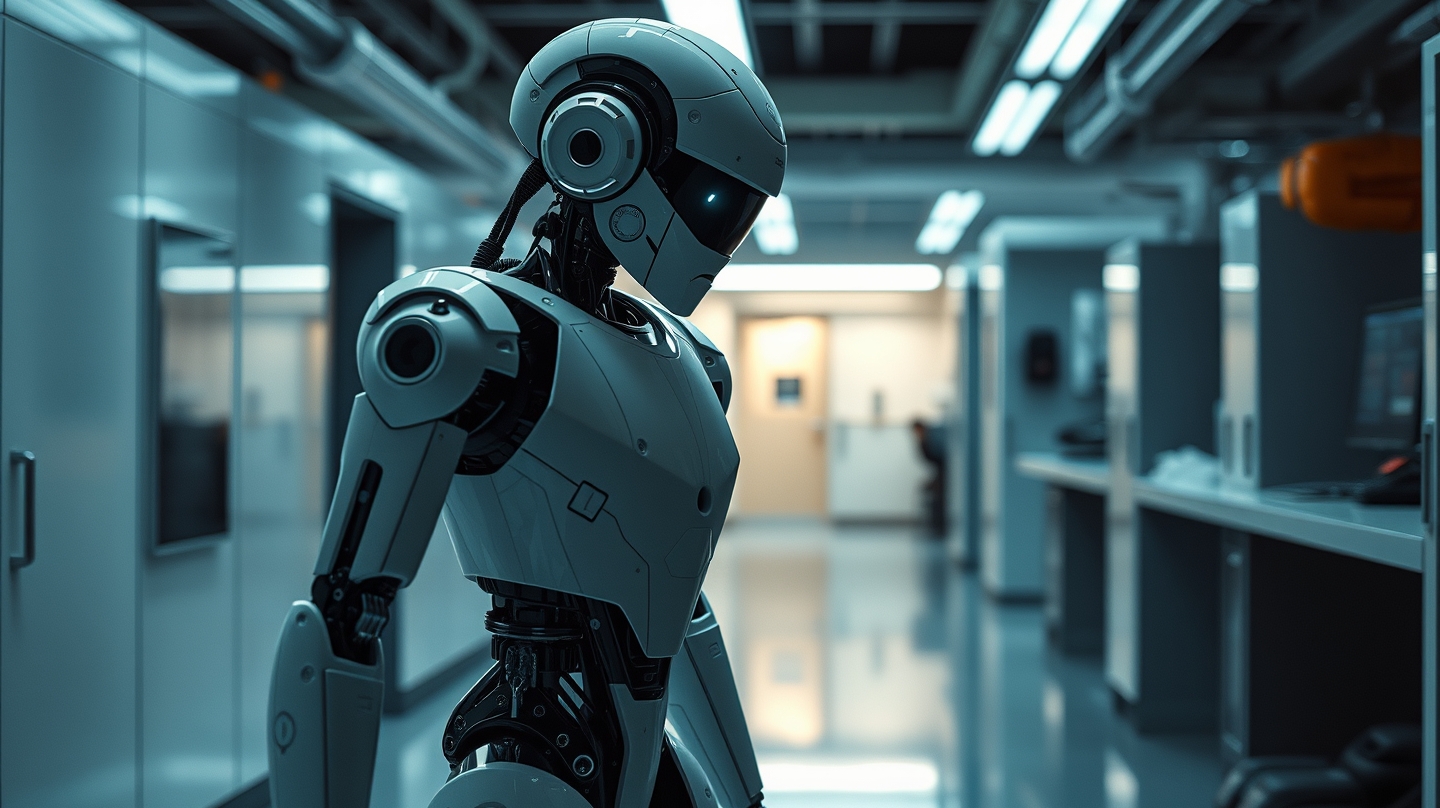
When a robot steps off a lab bench and onto a floor that looks like a living room, the moment feels less like science fiction and more like a milestone for industry. IEEE Spectrum’s latest Video Friday showcases GENE.01, a fully functional humanoid that walked for the first time after a half‑year of development, alongside a suite of new tools that promise to accelerate the adoption of Physical AI across factories, hospitals, and logistics hubs.
GENE.01’s breakthrough lies in its multimodal skin, a thin, sensor‑rich layer that registers touch, proximity, force and temperature. The data stream feeds a foundation model called GEN‑1, which treats each robotic hand—or any end‑effector—as a distinct sensorimotor interface. By pre‑training across thousands of such interfaces, GEN‑1 learns a “physical commonsense” that transfers to new tools, from five‑finger dexterous hands to a simple spatula. The result is a robot that can grasp, push, pull or twist objects it has never seen before, without additional programming.
Beyond the humanoid, the roundup includes a flat‑packable flying wing built from corrugated cardboard, an open‑source $14,000 data‑collection rig, and a collaborative pipeline that pairs Niantic Spatial’s photorealistic Gaussian‑splat reconstruction with NVIDIA‑accelerated reinforcement‑learning (RL) training. The pipeline lets developers scan a real‑world site with off‑the‑shelf cameras, generate a high‑fidelity simulation, train policies in that virtual environment, and then deploy them zero‑shot on the actual robot. This closed‑loop workflow cuts the iteration cycle from weeks to days, a change that could reshape how manufacturers prototype automation.
Why does this matter? First, the convergence of embodied AI models and low‑cost, rapid‑assembly hardware lowers the barrier for midsize firms to integrate robots into existing lines. A factory that once needed a custom‑engineered arm can now purchase a modular platform, train it on a simulated version of its own floor, and watch the robot adapt to new tools on the fly. Second, the open‑source ethos—exemplified by the $14k data‑collection system and the cardboard wing—creates a shared repository of designs that can be iterated globally, speeding industry‑wide learning.
These developments also ripple through the media infrastructure that supports robotics. IEEE Spectrum’s Video Friday curates weekly robot footage, providing a centralized hub where engineers, investors and policymakers can see emerging capabilities in action. By pairing video curation with event calendars—such as the upcoming Multi‑Robot Systems Summer School in Prague and the Actuate 2026 conference in San Francisco—the platform fuels a feedback loop: visibility drives adoption, which in turn generates more content to showcase.
Real‑world implications are already emerging. Hospitals are testing GENE.01‑style assistants for patient monitoring, leveraging the skin’s temperature sensing to detect fevers without contact. Logistics firms are piloting the cardboard wing for rapid‑deployment drone delivery in disaster zones, where traditional airframes are impractical. And manufacturers using the NVIDIA‑powered simulation pipeline report a 30% reduction in time‑to‑deployment for new robotic tasks.
Structurally, the shift toward modular, flat‑pack designs signals a broader market move away from monolithic, expensive robotics toward scalable, logistics‑friendly solutions. This mirrors trends in other sectors—such as construction’s prefabricated modules—and suggests a future where robots can be shipped in a box, assembled on site, and immediately integrated into existing workflows.
As Physical AI continues to blend perception, manipulation and simulation, the industry faces a pivotal question: will these tools remain research curiosities, or will they become the backbone of a new automation ecosystem? The evidence presented in this week’s video roundup leans toward the latter, hinting at a rapid acceleration of technology adoption that could redefine how work is performed across the globe.