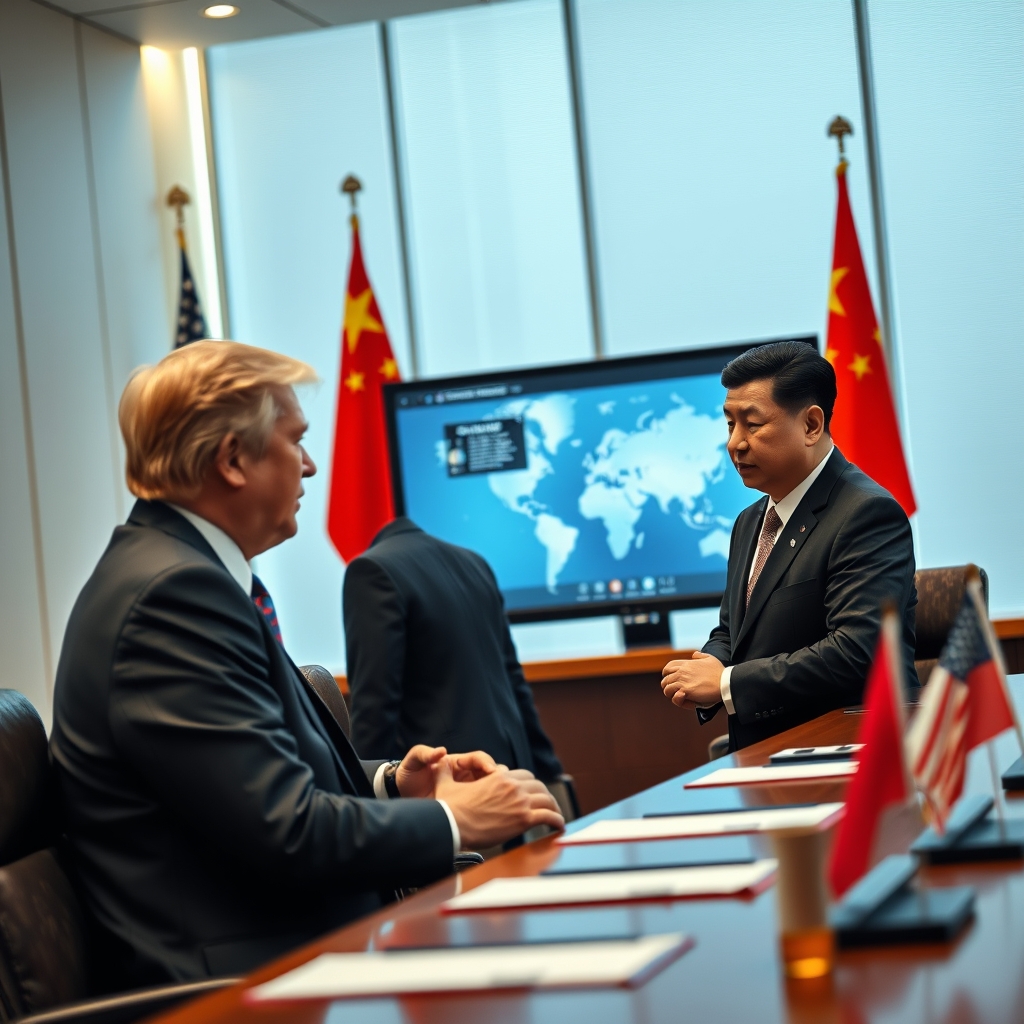
When Chinese President Xi Jinping arrived in Washington for a state visit, the White House announced a new, unexpected diplomatic tool: a hotline dedicated to artificial intelligence. The "US‑China Super Intelligence Dialogue" will convene its first formal talks by November, and a parallel channel will handle AI‑related incidents in real time. The arrangement mirrors the Cold War-era "red phone" that linked the Kremlin and the White House, a comparison made by U.S. Trade Representative Jamieson Greer.
At first glance, the line appears to be a confidence‑building measure, but its timing and structure reveal deeper strategic calculations. Both nations acknowledge that AI development is accelerating faster than existing governance frameworks can keep pace. By establishing a direct communication path, Washington and Beijing aim to reduce the chance of accidental escalation stemming from autonomous systems, while still pursuing aggressive national AI agendas.
Why does this matter? AI is rapidly becoming the backbone of financial services, supply‑chain automation, and national security. A miscommunication—or a rogue algorithm—could trigger market volatility, disrupt cross‑border payments, or even affect critical infrastructure. The hotline therefore serves as a risk‑mitigation layer that could stabilize markets that are increasingly sensitive to AI‑driven shocks.
For investors and institutions, the announcement has already sparked a measurable reaction. Stock indices tracking technology and semiconductor firms saw modest upticks in the hours after the news, as traders interpreted the move as a sign that geopolitical friction over AI may be managed through dialogue rather than outright confrontation. Meanwhile, large banks and asset managers are revisiting their AI risk frameworks, incorporating the possibility of coordinated regulatory signals from both Washington and Beijing.
From a structural perspective, the dual‑track design—one track for strategic dialogue, another for incident response—reflects a layered governance model that could become a template for other emerging technologies. It acknowledges that strategic policy discussions and operational safety concerns require different tempos and confidentiality levels. This separation may also allow faster resolution of AI incidents, such as unintended model outputs that affect financial markets, without derailing broader strategic negotiations.
The broader implication is a subtle shift in how superpowers manage technology competition. Rather than seeking to halt each other's progress, both sides appear to be betting on a managed race: continue domestic AI investment while establishing safeguards against unintended consequences. This mirrors a trend in other domains, such as space and biotechnology, where bilateral communication channels are being reinstated to prevent accidents.
Nevertheless, the hotline does not guarantee a slowdown in AI development. Treasury Secretary Scott Bessent, speaking earlier this year, emphasized that the United States will not curb its own AI work even as it engages China on risk mitigation. The line is therefore less a brake and more a buffer, intended to keep the competition from spilling over into economic or security crises.
Financial institutions stand to feel the ripple effects most directly. Compliance teams are already drafting contingency plans that reference the new dialogue, while investment committees are weighing the potential for coordinated policy moves that could affect AI‑related capital allocation. In practice, a rapid, bilateral response to an AI incident—such as a flash‑crash triggered by algorithmic trading—could limit losses and preserve market confidence.
In sum, the US‑China AI hotline represents a pragmatic response to a technology that is reshaping global finance and security. Its success will hinge on the willingness of both governments to engage transparently, the robustness of the incident‑response protocol, and the ability of markets to absorb the added layer of diplomatic oversight without stifling innovation.