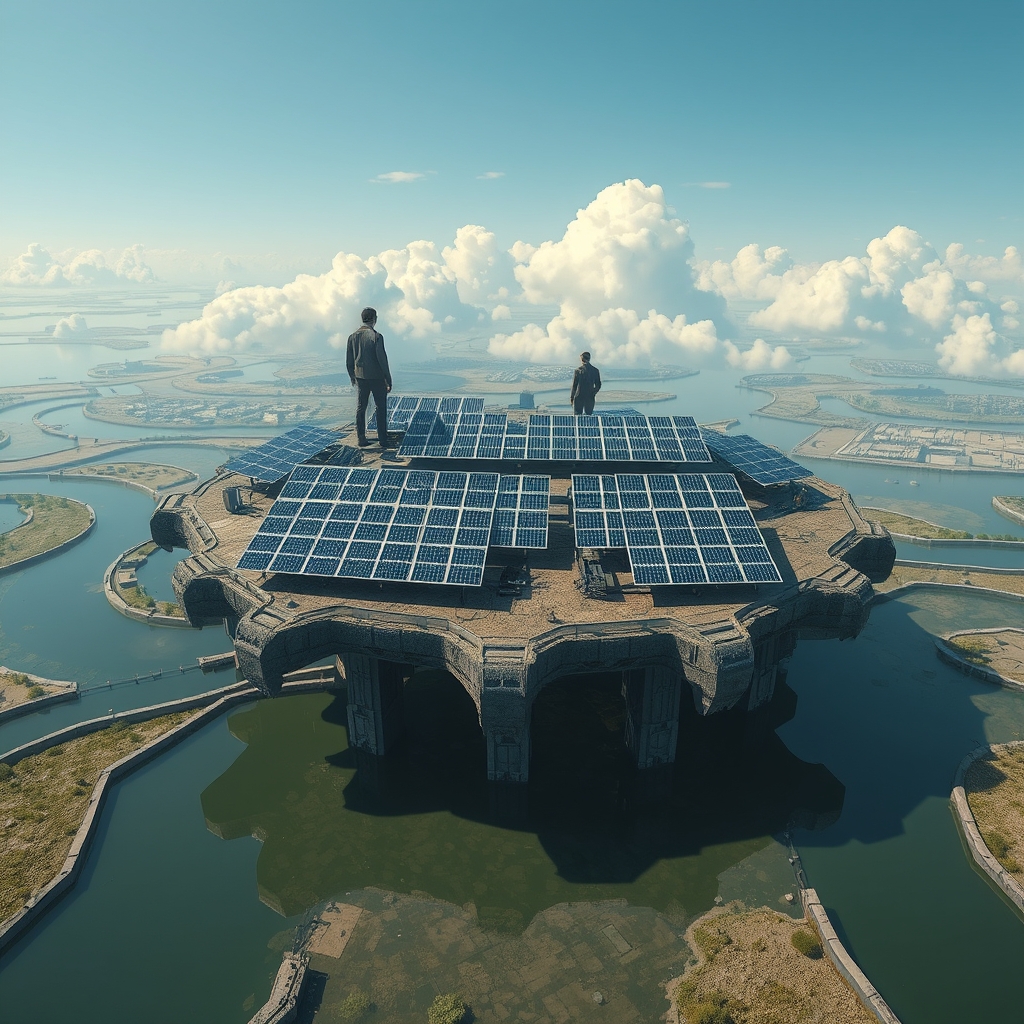
When architects design on water or in orbit, the familiar municipal web of power lines, sewers and roads disappears. The challenge then becomes not just where to place a building, but how to embed the entire infrastructure—energy, water, waste, mobility—into the structure itself. Projects such as the Maldives’ Waterstudio.NL floating city and Busan’s OCEANIX platform illustrate how automated systems are turning that challenge into a new design language.
In the Maldives, sea‑level rise has turned the nation’s low‑lying atolls into a pressing urgency. Waterstudio.NL responded with a lagoon‑based development that replaces streets with canals, and concrete foundations with telescopic steel stilts. What sets the project apart is its reliance on sensor‑driven water management. Real‑time flow meters and AI‑optimized pumps adjust water levels and quality without human intervention, keeping the floating units stable while preserving the surrounding coral banks.
Busan’s OCEANIX, a collaboration that includes UN‑Habitat and BIG, scales the same idea to a larger urban footprint. The platform’s neighborhoods are powered by photovoltaic panels that feed a micro‑grid managed by an autonomous energy‑balancing algorithm. Closed‑loop water treatment uses robotic valves and predictive maintenance to reduce downtime. Food production is handled by vertical farms whose lighting and irrigation are adjusted by machine‑learning models that react to weather forecasts and consumption patterns.
Both projects demonstrate a shift from “infrastructure as a backdrop” to “infrastructure as a design element.” Automation reduces the need for on‑site staff, allowing residents to focus on living, working and researching. The result is a tighter feedback loop: data from sensors informs design tweaks, which in turn improve system efficiency. This loop mirrors trends in media production, where automated workflows now handle everything from footage ingestion to distribution, suggesting that the same technology stack could support future architectural media—real‑time visualizations of a city’s energy flow, for example.
Why does this matter for cities on the ground? The same modular, self‑contained systems can be retrofitted into coastal districts vulnerable to flooding. By treating a building as a micro‑city, municipalities can extend services without overhauling legacy networks. Moreover, the data‑centric approach creates a new layer of transparency: residents can see how much energy their neighborhood generates, how water is recycled, and even how waste is processed, fostering a culture of accountability.
Looking beyond Earth, the absence of any existing grid makes automation indispensable. A lunar settlement would need to generate power, recycle air and water, and manage waste—all without human‑supervised maintenance crews. The lessons learned from floating platforms—particularly the integration of autonomous resource loops—provide a template for off‑world habitats.
In practical terms, the rise of automated infrastructure reshapes industry supply chains. Manufacturers of modular hulls now embed sensors at the factory stage, and software firms develop platform‑agnostic control systems that can be deployed on a floating city or a lunar base with minimal re‑coding. This convergence of construction and technology accelerates the adoption of digital twins, allowing planners to simulate years of operation before the first concrete (or steel) is placed.
Ultimately, the move toward self‑sufficient, automated platforms reflects a broader trend: cities are becoming collections of interoperable systems rather than monolithic entities. As climate pressures mount and space exploration advances, the ability to replicate a city’s essential services on any surface will be a decisive factor in where humanity chooses to live next.