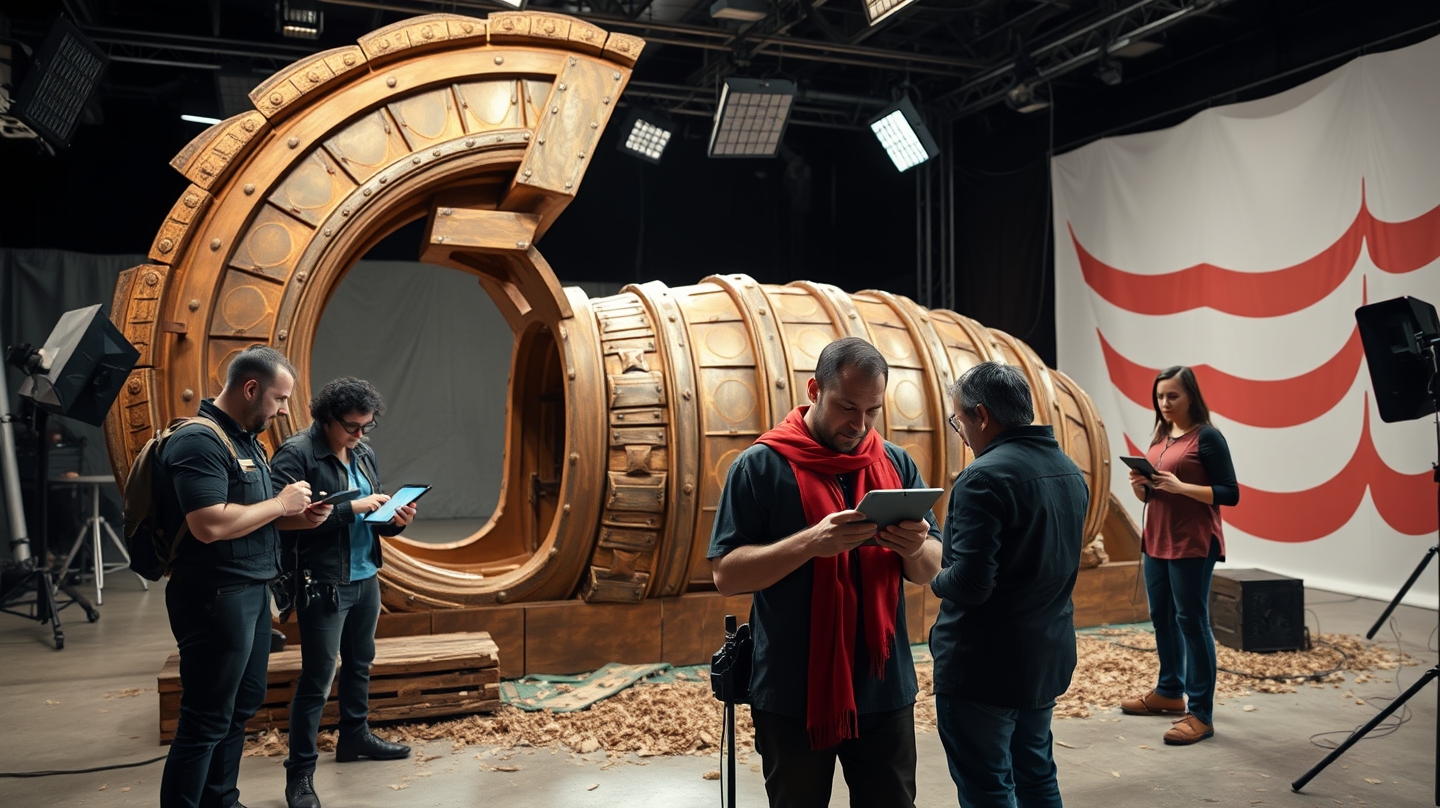
When the ancient tale of the Trojan Horse meets a cloud‑based production pipeline, the result is a format that promises to automate the most labor‑intensive stages of unscripted television. Mediawan’s rollout of the Kinetic Content‑created gameshow "Trojan Horse" across France, Spain, Italy, Germany, the Netherlands and Finland is more than a branding exercise; it is a testbed for technology‑driven workflow transformation in a market still dominated by manual set‑building and post‑production.
The premise is simple: teams confront a massive replica horse and must decide whether it hides a valuable prize or a hidden trap. Yet the execution relies on a suite of automation tools that coordinate set construction, real‑time data capture, and AI‑assisted editing. Sensors embedded in the set feed live metrics to a central dashboard, allowing producers to adjust lighting, camera angles, and even challenge difficulty on the fly. This level of dynamism, traditionally reserved for live sports, is now being applied to a scripted‑style game, reducing turnaround time from weeks to days.
Mediawan’s acquisition of Kinetic’s parent, The North Road Company, gave it immediate access to the proprietary workflow engine that powers Kinetic’s other hits. CEO Chris Coelen notes that the engine “standardizes asset ingestion, applies machine‑learning tagging, and auto‑generates rough cuts,” which means local adaptations can reuse core footage while swapping language tracks and cultural references. Elisabeth d’Arvieu, Mediawan’s group CCO, emphasizes that the format’s modularity “allows us to align several group companies around a single high‑potential format, building momentum for local adaptation while benefiting from shared expertise.”
From an industry perspective, the move signals a broader shift toward automation in media infrastructure. European broadcasters, facing tighter budgets and fragmented audiences, are increasingly looking for formats that can be produced at scale without sacrificing quality. By embedding AI‑driven editing and cloud‑based asset management into the heart of "Trojan Horse," Mediawan demonstrates that unscripted IP can be both globally recognizable and locally nimble.
The implications extend beyond cost savings. Real‑time analytics collected during each episode feed into audience‑behavior models, informing advertisers about engagement spikes and optimal ad placement. This data loop not only improves revenue predictability but also creates a feedback mechanism for future format tweaks, effectively turning each broadcast into a live laboratory for content innovation.
For talent and crew, the automation introduces new skill requirements. Set designers now collaborate with data engineers, while editors rely on AI suggestions rather than manual cuts. This evolution mirrors trends in other creative sectors where technology augments, rather than replaces, human expertise. The format’s success could encourage other producers to adopt similar pipelines, accelerating the industry’s migration toward a more digital‑first production ethos.
"Trojan Horse" also taps into a cultural moment where audiences crave interactive experiences that feel both familiar and novel. By marrying a well‑known myth with a game‑show structure powered by modern tech, Mediawan positions the format to capture viewers who are comfortable with streaming, gamified content, and rapid‑fire storytelling. The format’s adaptability—thanks to its automated backend—means it can be localized quickly, preserving the myth’s core while reflecting regional humor and customs.
In short, the rollout is a proof point that technology adoption can unlock new revenue streams, streamline production, and create a template for future unscripted formats. As European broadcasters evaluate the results, the industry will watch closely to see whether the blend of myth, game mechanics, and automation becomes a new standard for content creation.